
Find Your Foot or Ankle Concern

Start with the symptoms or diagnosis closest to yours. Similar symptoms can have different causes. These guides help you explore options; they do not establish a diagnosis.

Seek prompt local care for a new injury with deformity, a cold or numb foot, inability to bear weight, or a suspected Achilles rupture. Do not wait for an overseas consultation.

Acute Ankle Sprains & Ligament Injuries

A recent ankle sprain or suspected ligament tear? Assessment considers the injury pattern, stability and associated damage. Selected acute injuries may be considered for repair; not every sprain needs surgery.

Repeated Sprains & Ankle Instability

Does your ankle repeatedly roll, give way, or feel unreliable on uneven ground? Explore rehabilitation, ligament repair and other approaches to restoring stability.

Ankle Avulsion Fractures & Bone Fragments

A small bone fragment on a scan does not automatically mean surgery is needed. Understand how the fragment, ligament attachment and ankle stability may be related.

Talar Cartilage & Osteochondral Injuries

Diagnosed with an osteochondral lesion of the talus? Learn why its location, depth, stability and any underlying bone cysts matter when discussing treatment.

Bone Cysts, Achilles Injuries & Ongoing Symptoms

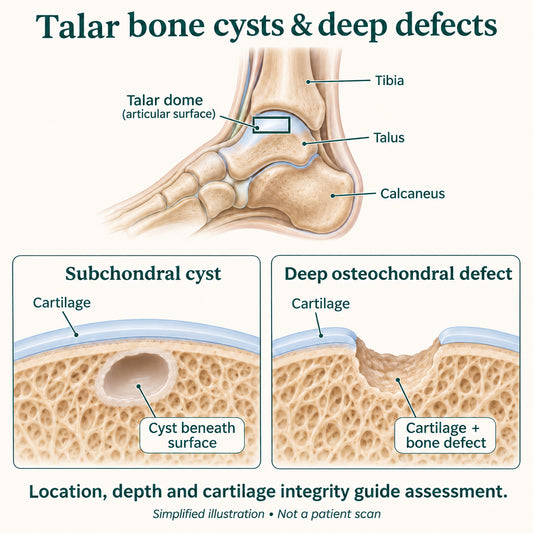
Talar Bone Cysts & Deep Bone Defects

A scan showing a talar bone cyst or a deep defect raises questions beyond the cartilage surface. Explore how the bone cavity, cartilage and defect shape guide discussion of drilling, bone grafting or reconstruction.

Achilles Tendon Rupture

Diagnosed with an Achilles tendon rupture and comparing surgery with nonsurgical care? Explore both treatment paths and the role of rehabilitation.

Persistent Ankle Pain, Catching & Associated Injuries

Pain, swelling or catching that persists may have more than one cause. Assessment may consider impingement, loose bodies, instability and associated cartilage or bone injuries before choosing treatment.

Ongoing Pain or Instability After Treatment

Still having symptoms after rehabilitation or surgery? Review the diagnosis, previous treatment, associated injuries and recovery progress. Persistent pain does not automatically mean a failed repair or a need for another operation.

Dr. Huige Hou’s Jinan University Ankle Ligament Treatment Framework

暨南大学 · Guangzhou, China

Dr. Hou’s framework connects the pattern of ligament injury with repair and reconstruction options and each patient’s needs.

九型 · Nine-Type Classification

Nine ATFL injury patterns describe the location, severity and remaining ligament tissue, helping Dr. Hou assess the injury before discussing treatment.

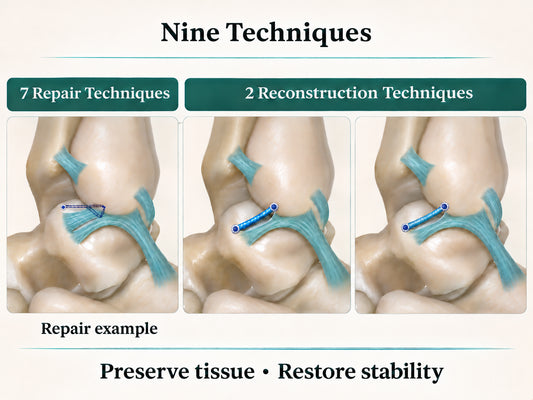
九剑 · Nine Techniques

Seven repair techniques and two reconstruction techniques provide different options. A type label alone does not prescribe an operation.

九选 · Individualized Treatment Selection

Dr. Hou considers nine assessment factors when selecting a suitable approach. These include body build, activity demands, ankle laxity, AOFAS assessment and injury severity. Surgery requires an individual indication.

ChondroFiller® (CF) Cartilage Repair with Dr. Huige Hou

Dr. Huige Hou has completed more than 100 CF procedures, with his clinical experience continuing to grow. He brings this hands-on experience to the assessment and treatment of selected talar cartilage defects.

A treatment plan that considers the whole ankle. His approach considers the damaged cartilage, the bone beneath it and ankle stability together. The size and depth of the lesion, any underlying bone cysts and associated ligament problems help guide an individual treatment plan.

Understand where ChondroFiller® fits. CF is a cell-free collagen gel scaffold used in selected cartilage repair procedures. Explore how it supports the repair approach, why deeper bone defects may need additional treatment, and what to discuss with Dr. Hou about suitability, rehabilitation and recovery.

Explore CF with Dr. Hou

Explore Foot & Ankle Treatment Options

Explore ligament repair and reconstruction, talar cartilage-and-bone treatment, associated ankle injuries and acute Achilles rupture care. The right approach depends on your symptoms, examination, imaging and previous treatment.

Assessment with Dr. Hou can help clarify suitable options, their risks and expected recovery. Availability of a specific procedure or material must be confirmed for your case.

JUMSA Arthroscopic Ankle Ligament Repair

For selected lateral ankle ligament injuries, repair is adapted to the tear location and usable tissue. Assessment considers fibular-side, midsubstance and talar-side injuries, including selected acute injuries. Not every acute sprain needs surgery, and the same repair is not suitable for every tear.

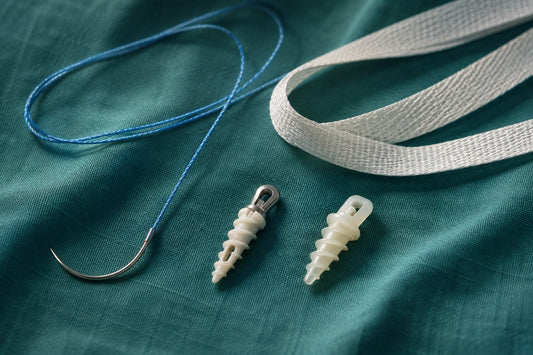
Suture, PLUS Suture & Suture-Tape Augmentation

Different suture patterns and suture-tape support may be considered in selected repairs. These differ from local ligament transfer or tendon-graft reconstruction. Laboratory strength does not establish faster recovery, and added support does not replace tissue healing or rehabilitation.

Avulsion Fragments & Associated Ligament Injury

Avulsion fragments can occur on the fibular or talar side of the outer ankle. Position, ligament attachment, bone quality and stability help guide preservation, fixation or removal, together with any ligament repair. Fragment size alone does not determine treatment.

Talar Cartilage & Osteochondral Lesion Repair

Treatment options include bone marrow stimulation, microfracture and selected use of a cell-free collagen scaffold. Treatment depends on the cartilage surface and underlying bone. A scaffold is not a stem-cell injection or a guarantee of restoring normal cartilage; suitability and availability require confirmation.

Talar Bone Cysts, Retrograde Drilling & Bone Grafting

Drilling to decompress a lesion differs from clearing a cyst and filling the bone defect. Cartilage integrity and the defect’s depth and shape guide discussion. C-arm or robotic assistance may help with access in selected cases; neither universal availability nor avoidance of osteotomy can be promised.

Acute Achilles Rupture: Surgery or Nonsurgical Care

Research involving Dr. Hou compares surgery and nonsurgical treatment for acute Achilles rupture, considering rerupture, other complications and rehabilitation. It does not cover every chronic Achilles problem or predict your personal outcome. Local assessment should not be delayed for an overseas consultation.

Local Ligament Transfer & Tendon-Graft Reconstruction

When remaining tissue may not support a reliable repair, assessment may include local ligament transfer augmentation or tendon-graft reconstruction. These are different approaches, supported by small clinical comparisons and laboratory research. Neither is best for everyone.

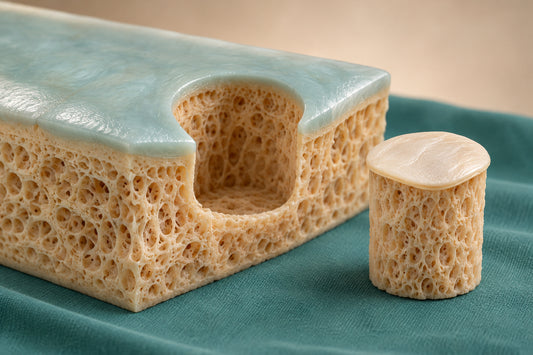
Complex Talar Reconstruction & Graft Options

Some deep or irregular talar defects need structural reconstruction as well as surface treatment. Options may include autologous bone or periosteal bone plugs, sometimes with a medial malleolar osteotomy for access. Suitability depends on your defect and clinical assessment.

Persistent Ankle Pain & Associated Injuries

Ongoing ankle pain may have more than one cause. Explore assessment of instability, impingement, loose bodies, and talar cartilage or bone injury—and when rehabilitation or surgery may be considered.

Understand the Decision Before Choosing a Procedure

A useful assessment explains not only what can be done, but why it is recommended, what alternatives exist and what remains uncertain.

Could Nonsurgical Care Still Help?

Rehabilitation, activity changes or bracing may still be worth considering. Assessment should review previous care and whether an associated injury needs timely treatment.

Explore Nonsurgical Care

Repair, Augmentation or Reconstruction?

Different methods place different demands on the remaining tissue. Understand why a clinician may recommend direct repair, additional support or reconstruction with a graft.

Compare Ligament Options

Still Having Symptoms After Treatment?

Persistent symptoms do not automatically mean another operation is needed. Review the diagnosis, operative records, associated problems and rehabilitation before deciding what comes next.

Explore Reassessment

Explore the Research—and Its Limits

Research by Dr. Hou and his collaborators informs treatment discussions. Differences in patients, methods and follow-up mean that study findings cannot promise an individual outcome.

Ankle Ligament Repair & Augmentation Research

Comparative studies explore outcomes after different repair and augmentation approaches. Improvement in one measure does not establish better pain relief, stability or long-term recovery across all outcomes.

Read a comparative repair study

Explore Ligament Research

Avulsion Injury Classification & Planning

Classification research helps describe fragments, their position and their relationship with ligaments. It supports treatment discussion, but classification alone does not prove that one treatment produces better outcomes.

Explore Fragment Research

Surgical vs Nonsurgical Achilles Treatment

A systematic review involving Dr. Hou highlights the need to consider rerupture, complications and rehabilitation together. It is neither a personal success rate nor a summary of all current evidence.

Read the systematic review

Compare Achilles Evidence

Research and Teaching Library

Clinical comparisons, laboratory studies, case reports and patents provide different kinds of information. These sources answer different questions and should not be treated as equivalent evidence. Where reports may include overlapping patients, their participant counts should not be added together. Teaching cases illustrate choices; they do not establish a personal success rate.

2021 Achilles rupture review — 13 randomized trials

2022 local ligament transfer comparison — 25 patients

2022 ligament biomechanics — 24 specimens

2024 modified suture comparison — 100 patients

2024 anchor versus tape biomechanics — 18 specimens

2025 talar-side TA/MTA comparison — 73 patients

2025 modified suturing versus InternalBrace — 50 patients

2025 responsive nano-lubricant research

2026 distal fibular avulsion classification — 152 patients

2026 modified all-inside repair — published technical report

2022 InternalBrace versus tendon reconstruction — 57 patients

2022 arthroscopic ATFL classification — 315 patients

2022 feasibility of distal fascicle transfer — 12 specimens

2023 standard versus modified suturing — 105 patients

Suture, PLUS suture and local transfer — 67 patients

2024 Jinan University type IIA comparison — 100 patients

2025 distal fibular avulsion classification — 147 patients

Three teaching presentations

Research & Instrument Innovation

Innovation also includes rehabilitation tools, surgical instruments and laboratory biomaterials research. A patent or an animal experiment is not evidence that a treatment is routinely available or effective in patients.

Rehabilitation & Surgical Instrument Patents

The patents cover an ankle lateral-muscle training device and an anterior talofibular ligament suture-puncture guide involving Dr. Hou. A patent records an invention; it does not establish clinical effectiveness or routine availability.

Patent references: ZL 202210781416.6 (CN 115228053 B); ZL 202321427946.7 (CN 220275672 U).

Biomaterials Research: Before Human Treatment

A 2025 collaborative study explored a responsive nano-lubricant using cell experiments and a rat knee osteoarthritis model. This is preclinical research, not a human ankle treatment, a commercial injection or evidence for talar collagen-scaffold outcomes.

Read the biomaterials study.

Image source: Zhang et al., Chemical Engineering Journal 522 (2025), 168085, Figure 1F (TEM) and Figure 1K (SEM). DOI: 10.1016/j.cej.2025.168085. © 2025 Elsevier B.V. These images characterize experimental materials, not results of treatment in patients.

Research and Instrument Innovation: Details

What do the two patent certificates document?

What did the responsive nano-lubricant study investigate?

Make Recovery Part of the Treatment Decision

For international patients, weight-bearing, practical assistance, travel and rehabilitation at home belong in the treatment discussion. There is no single recovery timetable for every condition or procedure.

Walking, Work & Sport

Being able to walk does not mean you are ready for sport. Explore how treatment requirements, functional progress and personal goals shape a staged return to activity.

Travel, Assistance & Daily Life

Before booking travel, discuss mobility, assistance, accommodation and assessment for the return journey. Hospital discharge timing alone does not determine readiness for a long flight.

Rehabilitation & Follow-Up at Home

Clarify rehabilitation needs, records for your local clinician and who to contact if problems arise. The availability and scope of follow-up services must be confirmed before treatment.

Dr. Huige Hou | Foot & Ankle Care

Foot & Ankle Patient Guides

Explore patient guides on the foot and ankle conditions treated by Dr. Huige Hou, including ankle sprains, ligament injuries and Achilles tendon ruptures. Understand assessment, treatment options and recovery, and prepare questions for your consultation.

Explore Dr. Hou’s Patient Guides

Explore an Assessment Before Deciding to Travel

Start with a free enquiry. Clarify your needs, the proposed service and its fees before deciding whether to prepare records or arrange a doctor video consultation.

Requesting an assessment does not book surgery or confirm that Dr. Hou will be the operating surgeon. Clinician involvement, treatment location and arrangements are confirmed separately.

1. Start a Free Enquiry

Tell our coordination team your country, main concern and what you would like help with. Full medical records are not needed for your first message.

2. Confirm the Service & Prepare Records

If you wish to proceed, confirm the paid service scope before preparing the requested imaging, reports and treatment history for coordination of an assessment involving Dr. Hou.

3. Discuss Options & Decide What Comes Next

A separately paid video consultation may be arranged if appropriate. An in-person examination or further tests may still be needed before deciding whether to travel.

Understand the Scope and Fees Before You Proceed

The free initial enquiry, assessment coordination, doctor video consultation and medical treatment are separate services. Before proceeding, clarify what is included, what costs extra and which terms apply.

What Is Free, and What Is Paid?

Your initial enquiry with the coordination team is free. Medical-record preparation and assessment coordination are paid services. Doctor video consultations are charged separately. Making an enquiry does not purchase a paid service.

What Should My Treatment Budget Include?

Alongside medical treatment, consider possible costs for tests, rehabilitation, interpretation, travel, accommodation and assistance. Items, availability and charges depend on the agreed service and treatment plan. A personalised estimate follows review of the proposed services and treatment.

What Should I Confirm Before Paying or Sharing Records?

Confirm the service provider, deliverables, fees, cancellation and refund terms, and how your records will be used and shared. The terms confirmed for the specific service apply.

Not Sure Where to Start?

Whether you have a diagnosis or simply want to understand the next step, tell us about your situation. Our coordination team can explain the assessment process, the records you may need and any proposed paid services.

Briefly include your country, preferred language, main symptoms or diagnosis, and any previous treatment. Please do not send identity documents or full medical records in your first message.

Start a Free Enquiry

Initial enquiries are handled by the coordination team and are not a medical diagnosis or an order for a paid service. Please read the Privacy Notice before submitting. For urgent symptoms, seek immediate local care. This page provides general information and does not replace an individual medical assessment. 

Service terms · Refund and cancellation

Related foot and ankle guides

JUMSA Repair · Suture and Tape Augmentation · Avulsion Fragments · Talar Cartilage Repair · Talar Bone Cysts · Achilles Rupture