


A Clearer Plan for an Ankle That Keeps Giving Way

Dr. Huige Hou · Jinan University (暨南大学), Guangzhou, China

Repeated sprains, uncertainty about a ligament tear, or different opinions about surgery? Dr. Hou’s 九型九剑九选 framework brings three questions together: What is injured? What can be done? Which approach fits you?

Understand the reasoning behind repair, reconstruction and rehabilitation before deciding on treatment.

Does This Sound Like Your Ankle?

These questions are a starting point for a discussion with Dr. Hou. Your symptoms, examination and previous treatment all matter.

“I Keep Spraining It.”

When does your ankle give way? How often does it happen, and which activities do you now avoid? Describe the pattern so Dr. Hou can understand how it affects your daily life.

“My Scan Says the Ligament Is Torn.”

The scan is one part of the assessment. Dr. Hou considers the findings alongside your symptoms, stability and the ligament tissue that remains; the scan alone does not decide treatment.

“Should I Have Surgery?”

Review your rehabilitation, ankle stability and activity goals together. The aim is to understand whether further nonsurgical care or a surgical discussion is appropriate for you.

Three Ideas That Work Together

What is injured? What can be done? Which approach fits you? Dr. Hou brings these questions together. The first decision is whether surgery is appropriate; rehabilitation matters with or without an operation.

九型 · Nine-Type Classification

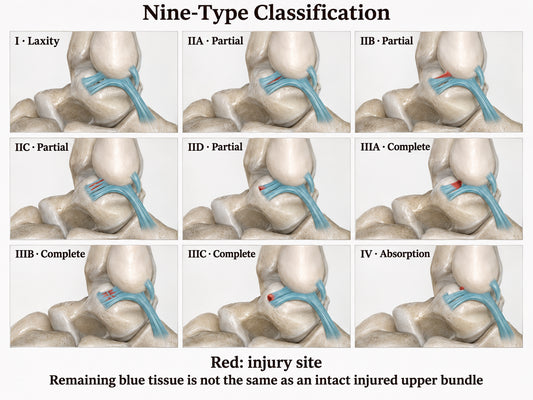
Understand the injury. Nine patterns within four main groups describe ATFL injury: laxity, partial tears, complete tears and absorption after injury. The affected upper bundle and remaining neighbouring tissue must be distinguished.

九剑 · Nine Techniques

Understand the options. The teaching framework describes seven repair techniques and two reconstruction techniques. A classification label alone does not prescribe an operation.

九选 · Individualized Treatment Selection

Match the technique to the patient. Dr. Hou describes nine assessment factors that guide selection from seven repair and two reconstruction techniques when surgery is indicated.

First, Understand the Ligament

The anterior talofibular ligament (ATFL) connects the fibula—the outer ankle bone—to the talus. Its upper and lower bundles form part of a wider lateral ligament complex.

The classification research focuses on arthroscopic injury patterns in chronic ankle instability, particularly the intra-articular upper bundle. A tear in that bundle does not mean that every neighbouring ligament has torn.

Dr. Hou examines the injury location, extent and remaining usable tissue. These details help explain why similar symptoms can lead to different treatment discussions.

九型 · Nine-Type Classification

Nine patterns within four main groups. Dr. Hou’s teaching illustration shows where and how ATFL fibres are injured. The original study examined arthroscopic findings in chronic ankle instability, particularly injury involving the intra-articular upper bundle.

Type I — Laxity. Continuity remains, but normal tension is lost. Looseness cannot be judged from a static picture alone.

Type II — Partial tears. IIA: inner fibular surface; IIB: upper fibular surface; IIC: within the ligament; IID: near the talar attachment.

Type III — Complete tears. IIIA: fibular attachment; IIIB: within the ligament; IIIC: talar attachment.

Type IV — Absorption after injury. The original classification describes absorption of the injured ligament. Remaining blue structures in the teaching illustration should not be mistaken for an intact injured upper bundle.

Ask Dr. Hou to identify the affected bundle and the tissue that remains in your ankle. Symptoms alone cannot identify a type, and a type alone does not select an operation.

What the Type Labels Mean

How are the nine labels grouped?

Can I identify my type from symptoms or MRI alone?

Does a complete tear always mean reconstruction?

More Than One Scan: How the Assessment Comes Together

Dr. Hou brings four parts of the assessment together to understand your ankle and discuss an appropriate plan.

Your Story

Explain when symptoms began, how often you sprain the ankle or feel it give way, and where it hurts. Include previous rehabilitation and any ankle surgery.

Your Examination

The pictured measurement checks ankle movement. Dr. Hou separately assesses stability, including clinical laxity tests where appropriate, and function. These findings are considered together; a movement measurement alone does not diagnose ligament instability.

Your Records

Imaging and earlier reports add structural information. Bring original images where available, together with previous treatment records.

Your Goals

Discuss work, walking and sport, as well as the recovery support available at home. These practical needs belong in your treatment discussion.

九剑 · Nine Techniques, Different Roles

Dr. Hou’s framework describes seven repair techniques and two reconstruction techniques. These cards explain three treatment roles through selected teaching examples. They are not a list of nine operations. A type label does not prescribe a technique. Ask which procedure is proposed and why it fits your injury and remaining tissue.

Repair · Use Suitable Existing Tissue

Repair reconnects or retensions suitable existing ligament tissue. The teaching example shows tissue supported by a suture repair. Dr. Hou considers the injury and the amount and quality of usable tissue alongside the wider assessment.

Ask: What tissue could be repaired in my ankle?

Augmentation · Add Support to a Repair

Augmentation adds support to a repair. This modified suture augmentation example shows a supporting suture construct working with remaining tissue. Modified suture augmentation and suture-tape augmentation are not interchangeable terms.

Ask: What tissue is being repaired, what provides support, and why is it needed?

Reconstruction · Restore Ligament Restraint

Reconstruction may be considered when the available tissue cannot support a suitable repair. The illustration shows one bridging configuration from Dr. Hou’s teaching materials. His source literature discusses rigid augmentation and tendon-graft reconstruction as distinct options.

Ask: Which technique and material are proposed, and why are they preferable to repairing my existing tissue?

Questions About Repair, Support and Reconstruction

Are JUMSA, suture tape and a tendon graft the same thing?

Why are there different repair configurations?

Where can I read about the specific options?

JUMSA: Can Usable Tissue Be Preserved?

Jinan University modified suture augmentation (JUMSA) is a core approach in Dr. Hou’s framework. His teaching describes ways to use remaining lateral ligament tissue in a modified suture repair.

Can useful tissue be preserved? His materials discuss repair in selected complete upper-bundle tears and injuries involving a distal fibular avulsion fragment. These are situations for individual assessment, not automatic indications for JUMSA.

The illustration presents one Type IIA teaching configuration. For other injury patterns, the tissue captured and suture arrangement differ. In the described complete-tear repair, upper-bundle and supporting secondary-bundle tissue can be repaired as a unit.

Ask Dr. Hou what can be preserved in your ankle, whether any bone fragment needs separate treatment, and why repair or reconstruction is the better fit.

Explore JUMSA Repair

九选 · Individualized Treatment Selection

九选 means selecting a suitable approach from the nine techniques after considering nine assessment factors. This follows a clinical decision that surgery is appropriate.

Dr. Hou’s explanation gives examples: body build, activity demands, anterior-drawer laxity, AOFAS assessment and ligament injury severity. These are selected examples, not the complete nine-factor checklist.

For you, the discussion is practical: what must your ankle do, how loose is it, how much pain and limitation do you have, and what tissue can be used? AOFAS considers pain, function and alignment.

Dr. Hou brings these findings together to explain a choice among seven repair and two reconstruction techniques. There is no self-scoring rule here and no automatic operation attached to a type number. If surgery is not appropriate, discuss a nonsurgical plan.

Discuss Your Treatment Options

Understanding Your Assessment

What do anterior-drawer laxity and AOFAS mean?

Can the same injury type lead to different plans?

Could Rehabilitation Still Be the Right Next Step?

A ligament injury does not automatically require surgery. Appropriate support and rehabilitation can address movement, strength, balance and control. For chronic instability, surgery is usually discussed when symptoms persist despite appropriate nonsurgical care and examination and imaging support the diagnosis. A fresh sprain needs its own assessment.

Support · Protect the Ankle

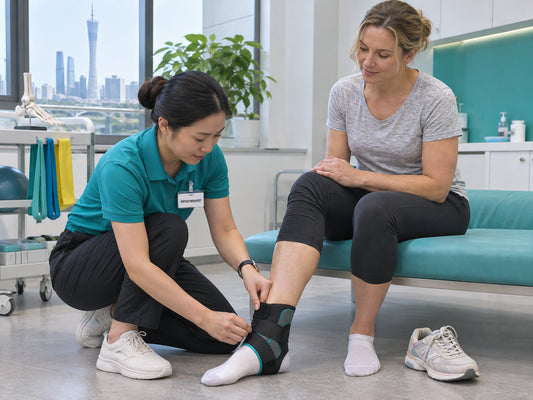
Appropriate support can be part of your nonsurgical plan. Discuss what support is suitable for your ankle, how it fits into daily activities and when it should be reviewed.

Ask: What support would you recommend for me?

Strength · Rebuild Movement and Control

A physiotherapist can guide exercises for ankle movement and strength. The pictured band exercise is one supervised example; the exercise, resistance and progression should fit your assessment.

Ask: What would further rehabilitation involve, and how will progress be reviewed?

Balance · Improve Stability in Activity

Balance and control are also part of rehabilitation. Review persistent giving-way episodes with Dr. Hou; chronic-instability recommendations should not be applied to every new injury.

Ask: What findings would make surgery a reasonable next step?

The Whole Ankle Matters

Associated injuries need their own assessment. Dr. Hou considers whether other structures contribute to pain or instability. Any additional procedure can change loading restrictions and rehabilitation.

Avulsion Fragments

A piece of bone may remain attached to an injured ligament. Its position, size and role in stability guide whether preservation, fixation or removal is discussed.

Cartilage and Underlying Bone

The cross-section shows the relationship between cartilage, a surface defect and underlying bone. A talar lesion needs its own treatment decision. ChondroFiller® (CF) may be considered for selected cartilage defects; it does not repair a torn ligament and is not one of the nine ligament techniques.

Other Sources of Pain or Instability

The outer ankle includes other ligaments and the peroneal tendons, which run behind the outer ankle bone. The pictured examination illustrates checking this region. Impingement and other causes of pain may also need assessment; treating one visible lesion may not address every symptom.

Recovery Belongs in the Treatment Decision

Agree on a plan for the actual procedure and any additional treatment. Protection, loading and return to activity vary; walking comfortably is not the same as being ready for sport.

Protect the Repair

Confirm the support or boot, wound review, permitted loading and exercises. Arrange help with daily activities and discuss travel timing with the treating team.

Rebuild Function

A physiotherapist guides movement, strength and balance under your rehabilitation plan. Pain, swelling and control help guide progression; extra fixation does not eliminate tissue healing.

Return with Clearance

Walking comfortably or completing a single balance exercise does not establish readiness for running or pivoting sport. Review movement, strength, stability and task-specific control with the treating team before advancing.

What the Evidence Means for Your Decision

Classification research describes injuries. Clinical comparisons examine particular treatments. Neither guarantees an individual result or proves the whole framework superior to all alternatives.

2022 · Understanding Injury Patterns

The 2022 study reviewed arthroscopic findings in 315 patients with chronic ankle instability. It supports describing injury patterns; it is not a patient self-diagnosis test.

2024 · Comparing Modified Repair

A 2024 matched comparison followed 100 patients for two years, comparing suture augmentation repair with modified suture augmentation repair. The modified group had a higher AOFAS score; pain and drawer-test results did not differ significantly. Better in one measure does not mean better in every outcome.

2025 · Different Outcomes, Different Perspectives

A 2025 retrospective matched comparison included 50 patients. AOFAS clinical scores favoured modified suture augmentation, while patient satisfaction favoured InternalBrace reconstruction. AOFAS considers pain, function and alignment. This study does not establish one best operation for everyone.

Risks, Expectations and Sources

What risks should I discuss before surgery?

How soon can I work, travel or return to sport?

Is this an internationally established nine-step standard?

Which sources explain the framework?

Questions Worth Taking to Your Appointment

Bring your symptom timeline, previous rehabilitation or surgery reports and original imaging where available. Write down the activities you most want to regain.

  • What explains my symptoms?
  • What are my nonsurgical options?
  • Why repair or reconstruct?
  • Are bone or cartilage problems involved?
  • What are the risks and recovery steps?
  • How will follow-up work at home?

Keep this discussion card or share it with a family member or your physiotherapist when preparing for a consultation.

Open the Discussion Card

What Happens After You Enquire?

Tell us your main concern. Include your country, preferred language, how long the problem has lasted and any previous treatment.

We explain the next steps. The coordination team will clarify the records needed and confirm arrangements for a review involving Dr. Hou. An online discussion may still need an in-person examination before treatment can be confirmed.

Understand the service before proceeding. Initial enquiries are free. Record preparation, assessment coordination and doctor video consultations are separate paid services; arrangements and fees should be confirmed in advance.

Return to Dr. Hou’s foot and ankle guide

Ask About an Assessment with Dr. Hou

This form reaches the coordination team. Submitting it does not book surgery or confirm a particular treatment. Please send a brief enquiry; do not include identity documents or full medical records.

Read the Privacy Notice, service terms and refund and cancellation terms.

For urgent symptoms after a new injury, including a deformed ankle, a cold or numb foot or inability to bear weight, seek prompt local medical care.