



What Is Cytoreductive Surgery (CRS)?

Understanding Cytoreductive Surgery

Cytoreductive surgery (CRS) is a major operation to remove visible cancer deposits. For selected patients with colorectal peritoneal metastases, the aim is complete removal of visible disease while preserving as much normal function as possible.

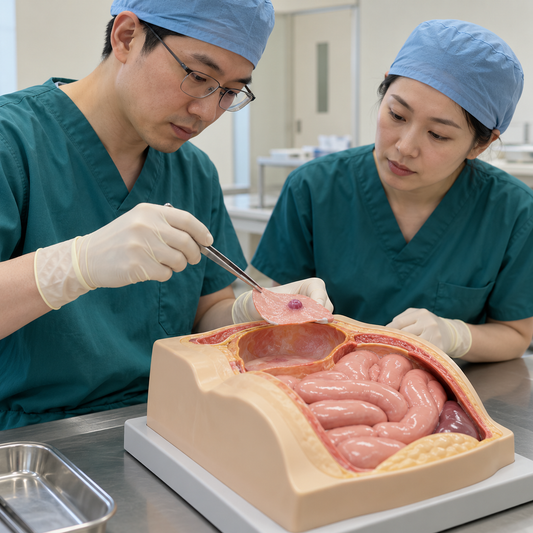
All illustrations on this page are AI-generated educational concepts or fictional scenes, not patient scans, real cases or photographs of the treating team.

The abdominal lining

The peritoneum is the thin lining inside the abdomen and over many abdominal organs. This page focuses on colorectal cancer that has spread to this lining.

Visible deposits on the surface

Peritoneal metastases are cancer deposits on these surfaces. Their size, number and location vary between patients; the illustration is not a scan or a diagnosis.

The surgical goal

CRS aims to remove visible tumour deposits in selected patients. Removing visible disease does not prove that microscopic cancer is gone or prevent all recurrence.

Could CRS Be an Option for Me?

A diagnosis of peritoneal metastases does not automatically mean that surgery is suitable—or impossible. Specialists consider these four areas together.

Where has the cancer spread?

The team reviews disease throughout the abdomen and any spread elsewhere. Distribution matters as well as the amount of disease.

Can visible disease be removed safely?

The surgeon assesses whether complete removal appears feasible and how it could affect bowel and other organ function. No online checklist can answer this.

How is the cancer behaving?

Pathology, relevant molecular findings, previous treatment and response help inform the recommendation. A single molecular result does not decide suitability alone.

How well could I recover?

Nutrition, strength, organ function and other medical conditions affect surgical risk. Your priorities and practical support are part of the assessment.

What Benefits Can CRS Offer—and What Are Its Limits?

Potential benefit and uncertainty belong in the same discussion. Ask how disease distribution, tumour biology and treatment history affect the balance for you.

Potential benefit: disease control

For carefully selected patients, CRS may be part of a plan intended to achieve long-term disease control, often alongside systemic treatment. Ask what benefit is realistic in your circumstances.

Important limit: recurrence remains possible

Cancer can return after apparently complete surgery. Follow-up and further treatment may be needed. Published results in selected groups cannot guarantee your outcome.

Questions worth asking

Clarify these points during your specialist discussion.

How should I interpret a success rate?

How Do Specialists Assess Whether CRS Is Appropriate?

Assessment brings together the diagnosis, disease extent and ability to recover. Further investigations may be needed before a recommendation.

01 · Confirm the diagnosis

Review pathology, the original cancer diagnosis and relevant molecular results. Confirm what type of disease is being treated before comparing treatment options.

02 · Review disease extent

Review imaging and previous operation reports. In selected cases, diagnostic laparoscopy may clarify findings that scans cannot establish.

03 · Assess surgical risk

Review nutrition, physical function, medicines, other medical conditions and organ function. The proposed extent of surgery also affects risk.

04 · Agree the treatment approach

Discuss surgery, treatment sequence, alternatives and your priorities with the relevant specialists. Confirm who will lead treatment and follow-up.

Questions worth asking

Clarify these points during your specialist discussion.

What is PCI?

What does complete cytoreduction mean?

What Happens During CRS? Will I Need a Stoma?

The operation is tailored to the location and extent of disease. The three concepts below are possibilities to discuss, not a procedure every patient will undergo.

Removal of affected peritoneal tissue

Surgery may involve removing involved peritoneal tissue and tumour deposits. The extent is tailored to the location of disease; this model does not represent every operation.

Possible bowel or organ removal

Involved sections of bowel or other organs may need removal. Ask how the anticipated operation could affect eating, bowel function and daily life.

A stoma may be needed

A stoma allows bowel contents to pass through an opening into a pouch. It may be temporary or permanent. Reversal depends on the operation, healing and subsequent treatment.

Questions worth asking

Clarify these points during your specialist discussion.

What if complete removal is not possible?

Is CRS the Same as HIPEC?

No. These treatments have different roles. The cards below are a comparison, not a fixed sequence or a package required for every patient.

CRS · Removes visible deposits

This is surgery to remove visible disease. The key question is whether meaningful removal is feasible with acceptable risk and impact on function.

HIPEC · Acts inside the abdomen

Heated chemotherapy is circulated within the abdominal cavity during a specialised procedure. Ask what evidence supports the proposed regimen for your cancer.

Systemic treatment · Acts throughout the body

Medicines such as chemotherapy and, when appropriate, targeted treatment or immunotherapy are selected according to the cancer and treatment history. Route and timing vary.

Questions worth asking

Clarify these points during your specialist discussion.

Does everyone having CRS also need HIPEC?

What Are the Risks of Cytoreductive Surgery?

CRS is major abdominal surgery and can cause serious complications. Individual risk depends on the extent of the operation and your health.

Complications at the surgical site

Bleeding, infection, leakage from a bowel connection and delayed or obstructed bowel function can occur. Some complications require another procedure or a longer stay.

Risks affecting the whole body

Blood clots and other serious complications are possible. The team assesses your health and plans monitoring and preventive measures; these do not remove all risk.

Additional care and treatment delays

A major complication may require intensive care or delay further cancer treatment. CRS also carries a risk of death. Ask about risks in comparable patients, not an unspecified overall success rate.

Questions worth asking

Clarify these points during your specialist discussion.

What should I ask about my individual risk?

What Is Recovery Like After CRS?

Recovery is gradual. These are areas of care, not a promised timetable. Surgery extent, complications, nutrition and further treatment all affect progress.

In hospital · Regaining basic function

Care includes monitoring, pain relief, supported movement and help while eating and bowel function recover. Progress differs between patients.

Nutrition · Adapting eating and drinking

Appetite and bowel habits may change. Ask for advice tailored to your operation and nutritional needs. A sample meal is illustrative, not a prescribed postoperative diet.

At home · Practical daily support

Plan help with everyday tasks, medicines, wound care and any stoma care. Fatigue may persist; increase activity according to your team's advice.

Follow-up · Recovery and further treatment

Review recovery and the next steps in cancer care. Discharge does not automatically mean fitness to fly or return to work. Obtain written warning-symptom and emergency-contact instructions.

What If CRS Is Not Recommended?

Ask why surgery is not recommended and what goals remain achievable. The next discussion should explain other options and how their benefit will be assessed.

Other cancer-directed treatment

Depending on cancer characteristics and previous treatment, the team may consider chemotherapy, targeted treatment or immunotherapy. Ask what the proposed treatment is intended to achieve.

Symptom relief and supportive care

Pain, bowel symptoms, nutritional problems and emotional concerns deserve care. Supportive and palliative care can accompany cancer-directed treatment.

Further review where appropriate

A second opinion, reassessment after treatment or a suitable clinical trial may be relevant. None guarantees that surgery will become possible or that a trial is available.

How Can I Assess the Team's Relevant Experience?

Look for an appropriate clinical background, research you can read and clear responsibility for your care. Academic activity does not by itself establish an individual surgical outcome.

Relevant clinical background

Professor Hui Wang's clinical and research work at the Sixth Affiliated Hospital of Sun Yat-sen University includes colorectal cancer and peritoneal metastases. This teaching image is not a photograph of him or his hospital.

Research you can inspect

Relevant publications examine prognosis, molecular features including BRAF, and CRS with or without HIPEC. Read the study population and limitations; research participation does not establish routine access to experimental treatment.

Questions worth asking

Clarify these points during your specialist discussion.

Who will be responsible for my care?

Planning a CRS Assessment in China

Clarify the review process, costs and continuity of care before making travel commitments. Recommendations and length of stay may change after assessment.

Records and translation

Formal review may require pathology, imaging and reports, operation records, treatment history and current medicines. Confirm translation requirements and a secure submission method before sharing records.

A written cost estimate

Ask what is included, excluded and subject to change: consultations, tests, surgery, anaesthesia, hospital care, additional treatment and possible complication or intensive-care costs. Clarify non-medical costs separately.

Travel, language and a companion

Confirm the receiving hospital, clinical team, appointments, language support and companion needs before booking travel. An inquiry does not confirm admission or an operation date.

Care after returning home

Agree who will manage follow-up, how information reaches your local clinicians and whom to contact if problems arise. Stay length and travel readiness depend on the individual course.

Your Questions and Next Steps

Start with an informed discussion. Use these three steps to prepare an inquiry without sharing sensitive medical information in the initial contact form.

01 · Prepare your questions

Write down what matters most: treatment options, daily function, a second opinion or practical support. You do not need to decide about surgery before asking how assessment works.

02 · Send basic contact details

Use the contact form for your name, email and general scheduling or language questions. Do not include medical records, identity documents or sensitive health details.

03 · Confirm the next steps

Confirm availability, receiving provider, fees and the formal review process. If records are needed, ask for a secure submission method. An inquiry does not establish eligibility or a doctor–patient relationship.

Frequently Asked Questions

Prepare for an informed specialist discussion.

Can a BRAF mutation alone decide whether I can have CRS?

Do published survival figures predict my outcome?

Should I book travel after sending an inquiry?

Can a family member help with the inquiry?

What should I ask at the consultation?

Ask About a CRS Assessment

Please provide your name, email and general contact or scheduling questions only. You may include your country and preferred language. Do not send medical records, identity documents or sensitive health details through this initial form.

Consultation availability, receiving provider, fees and arrangements must be confirmed separately. Submission does not confirm eligibility, admission or treatment.

Read our Privacy Policy

Medical Information and References

This page provides general education about CRS, with a focus on colorectal peritoneal metastases. It does not replace individual medical assessment. Options, risks and outcomes vary between patients. AI-generated images illustrate concepts and fictional scenarios; they are not real patients, facilities, treating teams or evidence of outcomes.

ASCO guideline on metastatic colorectal cancer · Mayo Clinic: CRS and HIPEC patient information · MSK: peritoneal metastasis consensus discussion

CRS with or without HIPEC: retrospective study, 2022 · BRAF and prognosis after CRS, 2023 · Professor Hui Wang: official hospital profile

Explore the peritoneal metastasis treatment overview