
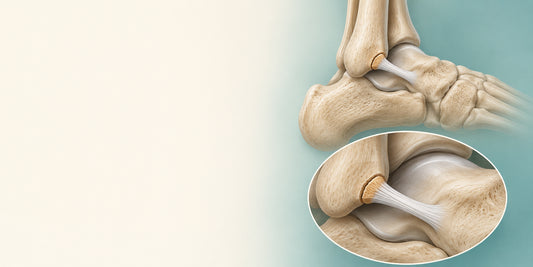
Does the fragment need to be left alone, fixed or removed—and what happens to the ligament attached to it? The right plan depends on symptoms, ankle stability, fragment position and tissue quality, not simply the words “bone fragment” on a scan.

Dr. Huige Hou and colleagues’ work on distal fibular avulsion fractures helps describe these differences. A useful assessment also looks for other causes of pain and considers whether nonsurgical care remains appropriate.

For a new injury with deformity, an open wound, a cold or numb foot or inability to bear weight, seek prompt local care. Do not wait for an overseas consultation.

First, Identify Which Injury You Have

A fragment near the outer ankle bone

A fragment on the talar side

How is this different from cartilage damage or a loose body?

What a Useful Assessment Should Answer

Is the fragment actually causing my symptoms?

Your history, tenderness, swelling, catching and giving way should be compared with examination and imaging findings. Describe when the injury occurred, any repeated sprains, previous treatment and the activities you cannot manage. A visible fragment does not necessarily explain every symptom.

Which scans would change the plan?

X-rays help assess bones and alignment. CT may clarify fragment shape and position; MRI or ultrasound may answer questions about ligaments and associated injuries. You do not automatically need every test. Arthroscopy-assisted measurements in selected surgical patients do not mean that everyone with a fragment needs diagnostic surgery.

Can it be fixed reliably?

Fragment position, displacement, bone quality and ligament attachment influence this decision. Size matters, but a single millimetre measurement cannot determine the best operation for every patient.

Can Nonsurgical Care Still Help?

A stable avulsion injury may be managed with protection and rehabilitation rather than surgery. Your clinician should define safe loading, any boot or brace, symptom management and review. A fragment on imaging alone does not establish a need for an operation.

If pain, swelling or giving way persists, review the diagnosis, previous care and associated injuries. Surgery should address an identified problem, not be triggered by a fixed short trial of rehabilitation.

Ask: What should improve, when should I be reassessed, and what findings would change the plan?

Preserve, Fix or Remove: What Changes the Decision?

Preserve without an operation

Preserve and secure a useful fragment

Remove a problematic fragment and address the ligament

Why Ligament Treatment May Be Part of the Plan

When might JUMSA repair be considered?

What if direct repair is not enough?

Benefits to Discuss—and Risks to Weigh

What improvement is realistic?

What could go wrong?

Could another injury need treatment?

Recovery Depends on What Was Treated

Protection and weight bearing

Ask whether you need a boot or brace, how much weight you may put through the foot and when healing will be reviewed. An uncomplicated stable avulsion treated nonsurgically has a different pathway from fixation combined with ligament or cartilage surgery.

Movement, strength and balance

Exercises progress within the restrictions needed to protect healing tissues. Recovery includes motion, muscle strength, balance and walking control. Do not copy another patient’s timetable or progress simply because pain has settled.

Returning home, work and sport

Before travelling, arrange follow-up and rehabilitation at home. Discuss wound review, repeat imaging if required, safe travel and clot-risk assessment. Return to sport depends on functional recovery and clinical clearance, not a guaranteed date. Physical work may require more recovery than desk work.

Research and Evidence Limits

What can this evidence tell me?

References and further reading

Questions Before You Decide

Does a fragment mean I need to travel for surgery?

Can video consultation determine the operation?

What should I prepare for a formal review?

Is the initial inquiry free?

Prepare These Records for Further Assessment

  • Symptoms, duration, and activity limitations.
  • Existing imaging reports and original images, if available.
  • Previous treatments and operation records.
  • Rehabilitation history and current medical conditions.
  • Your goals and access to follow-up care at home.

Ask About Assessment for Ankle Avulsion Fractures & Bone Fragments

Your initial inquiry is free and covers your main concerns and the service process; it does not include a medical diagnosis. Coordinating a case review or matching you with a physician involves a service fee. A physician video consultation is charged separately. Charges, required records and arrangements are explained before the service begins.

Dr. Huige Hou can participate in case review or video consultation, subject to record review and scheduling. For the first inquiry, briefly describe your concern without submitting identity documents or a full medical record. Instructions for providing records can follow if a formal review is arranged.

Please describe when the injury occurred, where the fragment was reported and whether pain, repeated sprains or both are your main concern.