



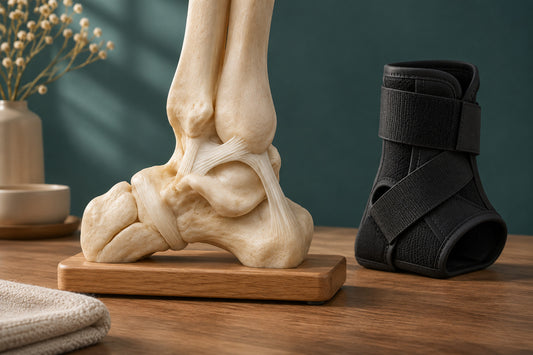




If your ankle repeatedly sprains or gives way, an MRI report describing ligament damage should not decide the next step on its own. Assessment should consider stability, the rehabilitation you have completed, and possible fragment, cartilage or underlying bone problems. Ligament studies involving Dr. Huige Hou inform surgical discussions, but do not replace this assessment.

When Is Nonsurgical Care Worth Reviewing?

The question is not simply whether you have had physiotherapy, but what it involved, how consistently you followed it and what changed.

Was rehabilitation complete?

If previous care mainly involved rest or passive treatment, a clinician can assess whether targeted strength, balance and movement-control work is appropriate. The plan should reflect your diagnosis and symptom response.

Is mechanical instability still present?

Recurrent sprains, giving way or ongoing activity limits after structured rehabilitation warrant reassessment of stability and associated injuries. A surgical assessment is not a commitment to an operation.

Ligaments, Cartilage and Bone Cysts Address Different Problems

Ligaments and movement control.

Rehabilitation addresses strength, balance and dynamic control; bracing may support selected activities. A brace does not replace assessment of structural instability that may need surgical treatment.

Talar cartilage injury.

Cartilage covers the joint surface. Treatment depends on symptoms and features such as lesion size, depth and location. Ligament rehabilitation or repair does not replace assessment of a cartilage lesion.

Talar bone cyst.

A talar subchondral cyst lies within bone beneath the joint surface and may be part of an osteochondral lesion. The cartilage surface and the supporting bone need to be assessed together. Decisions about drilling, debridement or grafting consider cyst size, the integrity of its wall, bone support and cartilage condition. Rehabilitation or surface cartilage treatment alone does not describe every option.

Set Clear Limits and Review Progress

Know When to Seek Reassessment

Recurrent instability, worsening pain or locking calls for reassessment. A suspected new fracture or Achilles rupture needs prompt medical evaluation, not automatic continuation of an old exercise plan.

Progress according to function.

Follow-up should track symptoms, motion, strength, balance and everyday function. Running and jumping require task-specific readiness; cartilage, graft or fracture treatment may add protection requirements.

What Can Dr. Hou’s Materials Tell Us?

Several ligament surgery studies enrolled patients with chronic ankle instability that persisted despite nonsurgical care. They help discuss surgical methods for selected patients, but do not establish that every recent sprain needs surgery or provide a personal nonsurgical success rate for Dr. Hou. The patent for a postoperative lateral-muscle training device documents an innovation; the certificate alone does not establish superior rehabilitation outcomes or current device availability.

Frequently Asked Questions

Does “complete tear” on MRI mean I must have surgery?

Can a brace replace rehabilitation?

Does ongoing pain mean nonsurgical treatment has failed?

Can I continue rehabilitation in my home country?

Which source materials support this discussion?

Prepare These Records for Further Assessment

  • Symptoms, duration, and activity limitations.
  • Existing imaging reports and original images, if available.
  • Previous treatments and operation records.
  • Rehabilitation history and current medical conditions.
  • Your goals and access to follow-up care at home.

Understand the Assessment Process Before Deciding

Your initial inquiry is free and covers your main concerns and the service process; it does not include a medical diagnosis. Coordinating a case review or matching you with a physician involves a service fee. A physician video consultation is charged separately. Charges, required records and arrangements are explained before the service begins.

Dr. Huige Hou can participate in case review or video consultation, subject to record review and scheduling. For the first inquiry, briefly describe your concern without submitting identity documents or a full medical record. Instructions for providing records can follow if a formal review is arranged.

Please describe how long symptoms have lasted, whether your ankle repeatedly sprains and any rehabilitation or bracing you have tried.