

A GUIDE FOR INTERNATIONAL PATIENTS

Acute Achilles Rupture: Surgery, Nonsurgical Care and Recovery

Choosing treatment after an Achilles tendon rupture involves more than deciding whether to have surgery. Rerupture, wound and nerve-related risks, functional recovery, and access to rehabilitation all matter.

Discuss the expected benefits and risks of each option with your clinician.

If you suspect a recent Achilles rupture, seek prompt local assessment and protection. Do not wait for an overseas consultation or travel arrangements.

The principal review discussed here concerns acute ruptures treated within four weeks of injury in participants older than 16 years; reruptures were excluded. It does not establish treatment results for chronic ruptures, reruptures or insertional tendinopathy. Dr. Hou’s participation in this review is not evidence of a unique Achilles operation developed by him.

The initial enquiry is with our coordination team and is not a medical diagnosis. Record preparation, assessment coordination and doctor video consultations are paid services.

First, Clarify the Injury

The timing, location and treatment history of your injury affect the options. A recent rupture, a longstanding rupture, a rerupture and tendon pain without rupture require different assessments.

A Sudden Pop and Difficulty Pushing Off?

A sudden snapping sensation behind the ankle or calf, followed by difficulty pushing off, needs prompt assessment. Do not repeatedly stretch or perform heel raises to test the injury yourself.

What Should the Assessment Establish?

Your clinician assesses the rupture location, extent and tissue condition using your history, examination and imaging when needed. A screenshot or a single gap measurement should not determine treatment on its own.

A Delayed Presentation or Another Rupture?

These situations need a separate assessment. The meta-analysis involving Dr. Hou excluded treatment delayed beyond four weeks and reruptures, so its findings cannot directly determine your treatment.

Assessment background: AAOS Achilles tendon rupture guide.

Nonsurgical Treatment Is an Active Treatment Pathway

Nonsurgical treatment is an option for selected patients. It requires timely assessment, protection of the healing tendon, supervised rehabilitation and follow-up.

Who Can Discuss Nonsurgical Care?

Some patients with an acute rupture may choose nonsurgical care after assessment of the injury, health, activity goals and rehabilitation access. Age or sporting interests alone should not determine the decision.

Protection Is Part of Treatment

A brace, cast or walking boot protects the tendon according to the treatment plan. Ankle position, weight-bearing and adjustments must follow your team’s instructions rather than another patient’s schedule.

Healing Needs a Rehabilitation Plan

Functional rehabilitation does not mean exercising early on your own. It introduces movement, loading and strengthening within prescribed limits. Reliable access to rehabilitation at home matters when choosing treatment.

Begin movement and loading exercises only when your clinical team confirms they are appropriate for your stage of recovery.

Nonsurgical care avoids an operative incision, but rerupture, incomplete recovery and further treatment remain possible.

Background: CUH patient guide. Its specific protocol is not a universal prescription or Dr. Hou’s protocol.

Surgery: What Is Repaired, and How Is the Approach Chosen?

Surgery aims to repair the torn tendon, but protection and rehabilitation are still necessary. Whether to operate, and which approach to use, depends on the injury and individual risks.

When Might Surgery Be Considered?

The discussion includes the rupture pattern, tissue quality, activity demands and your priorities regarding rerupture and surgical risks. High sporting demands deserve attention but do not prove that surgery will deliver a better or faster recovery.

Open Repair: Direct Access to the Torn Tendon

Open repair exposes the rupture through an incision. The discussion should include wound healing, infection, scarring and nerve-related risks, as well as the tendon repair itself.

Smaller Incisions Do Not Remove the Risks

Minimally invasive or percutaneous methods use smaller incisions. The choice still depends on the rupture, tissues and nerve protection. Current evidence does not establish one approach as best for every patient.

Achilles tendon repair and JUMSA ankle ligament repair treat different structures.

Background: AOFAS position statement.

Understand the Trade-offs, Not Just the Procedure

A lower rerupture risk does not mean every outcome is better. Avoiding surgery does not mean avoiding all risks.

Rerupture Can Occur With Either Pathway

The pooled research involving Dr. Hou found fewer reruptures overall after surgery. However, differences in patients and rehabilitation mean these findings are not your personal risk percentage.

Surgery Adds Risks That Need Discussion

The research examined wound infection, scar adhesion and sural nerve injury, which can cause altered sensation. Your risk depends on the procedure and individual health factors.

Tendon Healing Is Not the Same as Full Recovery

Weakness or functional limitations may remain after either treatment. The paper did not establish that surgery gets every patient back to work faster or reliably restores preinjury sporting ability.

Both pathways require assessment of blood-clot risk. Seek prompt care for new significant calf swelling or pain, and emergency help for chest pain or breathlessness.

Recovery Is Guided by Milestones

Your plan should explain what is allowed at each stage, what to avoid and who will review your progress. There is no guaranteed date for walking, running or returning to work.

Protect the Tendon and Know the Rules

Clarify boot use, weight-bearing restrictions, follow-up and wound care if you have surgery. Do not independently increase stretching, adjust boot wedges or stop protection.

Rebuild Walking and Calf Strength Gradually

Your team progresses rehabilitation according to recovery. Less pain or the ability to walk does not mean the tendon is ready for running and jumping.

Work, Driving and Sport Need Separate Decisions

Desk work, prolonged standing, physical work and competitive sport place different demands on recovery. Return decisions should consider ability and clinical assessment, not just elapsed time.

Recovery can take many months, and higher-level sporting recovery may take longer. Before travelling, clarify who will provide rehabilitation and follow-up after you return home.

What Does the Research Involving Dr. Hou Tell Us?

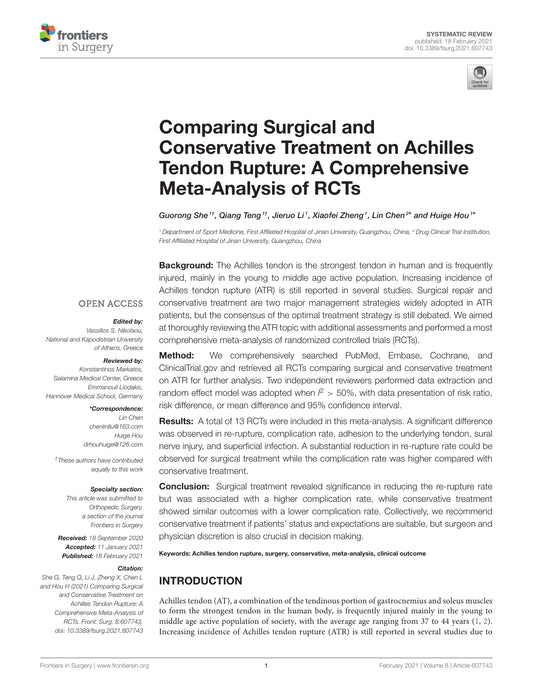
Dr. Huige Hou was a co-corresponding author of a 2021 meta-analysis of 13 randomized trials comparing surgical and nonsurgical treatment for Achilles tendon rupture.

Its value is in explaining trade-offs between rerupture, complications and functional outcomes—not in proving that one operation suits everyone.

Surgery was associated with fewer reruptures overall. Complications other than rerupture were more frequent after surgery in the pooled studies. Several functional comparisons found no significant difference, but some outcomes were supported by few studies. Study findings do not replace an individual assessment.

This was a review of existing trials, not a report of Dr. Hou’s personal surgical outcomes.

Read the Study Involving Dr. Hou

Understanding the Evidence

The 2021 review searched evidence up to July 2020 and excluded treatment delayed beyond four weeks and reruptures. It cannot determine treatment for chronic or recurrent ruptures.

Source: She G, Teng Q, Li J, Zheng X, Chen L, Hou H. Frontiers in Surgery, 2021;8:607743.

Does “no significant difference” mean the treatments are equivalent?

What does more recent independent research add?

Source and Scope of the Achilles Comparison

Which research supports this discussion?

Plan an Assessment Before Planning Travel

If you have already received initial local care and want to understand your options, start by preparing your records. An assessment may support continuing your current treatment rather than arranging surgery.

What Records Should You Prepare?

Prepare the injury date, diagnosis, reports and available imaging, previous treatment, current protection and rehabilitation plan, and work or sporting goals. Include the operative report if you have had surgery.

What Should the Assessment Clarify?

Dr. Hou can participate in case assessments or video consultations, subject to confirmed arrangements. Questions may include diagnostic certainty, the current plan, treatment alternatives and whether an in-person examination is needed.

Clarify Fees and Follow-up Before Booking

The initial coordination enquiry is free. Fees for record preparation, assessment coordination and doctor video consultations are explained separately. Confirm treatment, rehabilitation, accommodation and travel costs, together with follow-up at home.

Frequently Asked Questions

Does a complete Achilles rupture always need surgery?

Does being active mean surgery is better for me?

Is minimally invasive repair always safer or faster?

Can the plan be reassessed after starting nonsurgical care?

When can I walk, drive, run or fly?

Can a video consultation determine my final surgical plan?

Study Population and Interpretation

Source: She et al., Frontiers in Surgery (2021), DOI 10.3389/fsurg.2021.607743.

Who was included in the 2021 review?

How did the authors interpret the trade-off?

Which source materials support this discussion?

Would You Like Help Preparing the Next Step?

Tell us when the injury happened, your current diagnosis and your country. Our coordination team can explain record preparation and the assessment process. Recent injuries should receive local care first.

  • Injury date and current diagnosis
  • Available reports and original imaging files
  • Previous treatment and operative records
  • Current boot, protection and rehabilitation plan
  • Work and sporting goals
  • Country and follow-up arrangements at home

Send My Free Initial Enquiry

The initial enquiry is with the coordination team and does not include a diagnosis or individualized treatment plan. Case preparation and assessment coordination are paid services; doctor video consultations are charged separately. Submitting this form does not purchase a service.

Do not include passport numbers, payment details or complete sensitive medical records in the initial message. Instructions for submitting detailed records will follow. Patient education does not replace individual assessment. Research findings do not guarantee personal outcomes.

Explore Dr. Hou’s Foot & Ankle Guide · Ankle Ligament Repair: A Different Injury · Privacy Notice · Service Terms

Related foot and ankle guides

JUMSA Repair · Suture and Tape Augmentation · Avulsion Fragments · Talar Cartilage Repair · Talar Bone Cysts · Achilles Rupture