


A GUIDE FOR INTERNATIONAL PATIENTS

Understand Whether Extra Support Is Needed—and What It Changes

If your ankle repeatedly sprains or gives way, or you are comparing surgical recommendations, you may have heard terms such as suture augmentation, suture tape or InternalBrace.

These terms do not describe one identical operation. The important questions are which tissues need repair, what additional support is intended to achieve, and whether its expected benefit justifies the materials, costs and related risks.

The decision to operate—and whether to add augmentation—must be individualised.

Your first enquiry with our coordination team is free. Medical-record preparation and assessment coordination are paid services. Doctor video consultations are charged separately. Dr. Hou can participate in case assessments or video consultations, subject to confirmed arrangements.

Using Sutures Does Not Automatically Mean Augmentation

Sutures may perform the primary repair or form part of an additional augmentation construct. Understanding the difference requires an explanation of the actual procedure, not just its name.

Repairing or Reattaching Your Own Tissue

A standard ligament repair may use sutures and anchors to reattach or tighten usable tissue. The use of anchors or high-strength sutures alone does not establish that a separate augmentation construct has been added.

Similar Names Can Describe Different Constructs

“Suture augmentation” can describe different methods of suturing, fixation and tissue support. SA and MSA have specific definitions in the studies involving Dr. Hou. Procedures sharing the word “augmentation” should not automatically be treated as identical.

Understand the Material and the Branded Technique

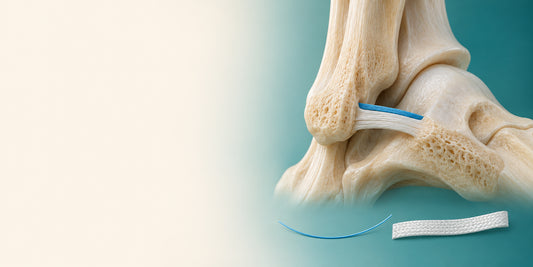
Suture tape is a tape-like suture material that may provide additional mechanical support. InternalBrace is an Arthrex-branded technique, not a generic name for every suture-tape augmentation. The manufacturer describes it as supporting a primary repair or reconstruction, rather than replacing the native ligament.

Terminology: Arthrex: InternalBrace ligament augmentation. Manufacturer information defines the product; it is not independent evidence of clinical benefit.

Is InternalBrace an Artificial Ligament Graft?

What does PLUS suture augmentation mean?

Compare the Proposed Procedure, Not a Ranking of Names

“Arthroscopic or open” describes the surgical approach. “Repair, augmentation or reconstruction” describes how stability is restored. These are separate questions to discuss.

Broström / Modified Broström-Gould Repair

The focus is repairing or tightening existing lateral ligament tissue. A Gould modification may reinforce the repair using nearby supporting tissue. A repair without suture tape is not automatically an incomplete treatment.

Ask: Can my tissue support a reliable standard repair?

A Repair Adapted to the Injury and Available Tissue

JUMSA (Jinan University Modified Suture Augmentation), associated with Dr. Hou’s work in Guangzhou, China, emphasises available tissue, injury location and the repair construct. Its name does not make it equivalent to InternalBrace or every suture-tape technique. The specific version, materials and fixation must be identified.

Adding Support to the Primary Procedure

If suture tape is recommended, the surgeon should explain its purpose in your plan and why repair alone may be less suitable. Greater initial mechanical support does not establish better long-term outcomes for every patient.

Ask: Which outcome is the tape expected to improve in my case?

A Different Option When Tissue Is Insufficient

If the remaining tissue cannot support a reliable repair, tendon-graft reconstruction may need discussion. Whether to add augmentation is a separate decision. Suture tape should not be assumed to compensate for every tissue deficit.

Ask: Why is this approach recommended over the alternatives?

Background: AAOS: sprained ankle; Dr. Hou’s JUMSA presentation and studies linked below.

Can an MRI Report Alone Decide Which Procedure I Need?

Identify the Problem Before Adding Materials

Repeated sprains do not mean everyone needs surgery, and surgery does not automatically require augmentation. An assessment should explain the reasoning behind each treatment choice.

Nonsurgical Treatment May Still Have a Role

If targeted strength, balance and movement-control training has not been completed, rehabilitation and bracing may still warrant discussion. Rest, pain relief or a brief course of therapy may not represent a complete instability rehabilitation programme.

Assess Surgery—and Whether Augmentation Adds Value

If significant giving way or repeated sprains persist despite appropriate nonsurgical care, surgical assessment may be reasonable. Tissue quality, activity demands and other relevant factors should inform whether additional augmentation is recommended.

Reassess the Whole Problem

A failed previous repair, substantial tissue loss, alignment problems or generalised ligament laxity may change the treatment choice. Repair, augmentation, reconstruction and other measures should be compared, rather than simply selecting a stronger material.

Does Being Active Mean I Need InternalBrace?

Is Augmentation Appropriate if Pain Is My Main Problem?

Extra Support Needs a Clear Purpose—and a Discussion of Trade-Offs

Supporting the Repair and Restoring Stability

Augmentation aims to provide support alongside the primary repair. Discuss this in terms of outcomes that matter to you—such as fewer giving-way episodes, better daily function or a staged rehabilitation plan—rather than material strength alone.

Materials, Fixation and Tension Matter

Discuss possible implant irritation, fixation-related problems and restricted movement from an overly tight construct. The surgeon should explain how these risks relate to the proposed materials, technique and your individual circumstances.

Augmentation Does Not Remove Surgical Risks

Risks include infection, wound problems, nerve irritation or injury, stiffness, persistent pain and recurrent instability. The 100-patient comparison reported superficial infections in both groups and one sural nerve injury in the suture-augmentation group. Small samples do not provide a reliable personal complication probability. Anaesthetic and blood-clot risks need separate discussion, and some patients may require further treatment.

Will the Tape Dissolve, and Will It Need Removal?

Recovery Depends on the Procedure and Your Functional Progress

These are recovery stages to discuss with your team, not a personal exercise prescription. Treatment of cartilage, bone fragments or other structures may change the plan.

Clarify Weight-Bearing and Movement Restrictions

Before discharge, clarify any boot or brace requirements, crutch use, restricted movements and review appointments. Less pain is not permission to advance activity independently.

Walking Is One Step in Rebuilding Function

Restore walking within the permitted plan, then continue strength, balance and movement-control training. Prolonged standing, physical work and uneven ground place different demands on the ankle from short indoor walks.

Match Readiness to the Activity

Ask separately about returning to desk work, physical work, driving, running and change-of-direction sports. Readiness should consider strength, control, symptom response and clinical clearance, rather than weeks since surgery alone.

General reference: ACFAS: chronic ankle instability. This is not Dr. Hou’s personal protocol or an individual prescription.

Can I Walk or Run Earlier After Augmentation?

Can I Continue Rehabilitation at Home?

Some Findings Are Encouraging—No Single Method Wins on Every Outcome

Studies differ in the procedures, patients and rehabilitation programmes they compare. Read each result within its own definition; these findings cannot be combined into one “augmentation success rate.”

Dr. Hou and collaborators · 2024

Modified Suture Augmentation Versus Suture Augmentation

This retrospective study compared 100 matched patients over two years. MSA had a higher AOFAS score, while pain and anterior drawer findings did not differ significantly. It was not a direct comparison of augmentation versus no augmentation.

Dr. Hou and collaborators · 2025

Clinical Scores and Satisfaction Favoured Different Groups

A single-centre retrospective study of 50 patients reported higher AOFAS scores with MSA and greater satisfaction with InternalBrace at approximately 21 months. The publication contains inconsistencies in group counts and statistical reporting. These findings do not establish overall superiority or reliable individual success and complication probabilities.

Other researchers · 2021 randomised study

Earlier Return to Activity Needs Context

In a multicentre randomised study of 119 patients, average return to preinjury activity was 13.3 weeks with suture-tape augmentation and 17.5 weeks with modified Broström repair. The complication difference was not statistically significant. These are not Dr. Hou’s personal results or your recovery timetable.

AOFAS combines pain, function and alignment in a 100-point clinical score; it is not a percentage success rate or a measure of sports performance alone. InternalBrace augmentation and tendon-graft reconstruction remain different procedures, even when a study uses the word “reconstruction” for both.

What Remains Uncertain?

Which source materials support this discussion?

A Useful Assessment Goes Beyond the Technique

Compare Against the Plan You Already Have

If you already have a recommendation, explain which ligaments would be treated, whether augmentation is proposed, the materials and rehabilitation requirements. A further assessment should clarify differences and may support continuing care locally.

Compare the Full Cost and the Actual Materials

Clarify coordination, doctor consultation, surgery, implants, rehabilitation, interpretation and travel costs separately. Do not assume treatment in China will always cost less or that a particular brand is available. Estimates should correspond to a defined service and treatment scope.

Discharge Does Not Automatically Mean Fitness to Fly

Travel planning should consider wound status, mobility, clot risk and follow-up needs. Before travelling, clarify rehabilitation at home, transfer of medical records and who will provide local care if complications occur.

Travel guidance: CDC: medical tourism.

Will Dr. Hou Assess Me or Perform the Operation?

What About English Communication, Insurance and Cancellation?

Additional Research and Its Limits

2024 suture-tape biomechanics: 18 specimens

Would You Like to Understand Whether Augmentation Is Relevant to Your Plan?

You do not need to decide on surgery or upload a complete medical file with your first message.

Tell us what you most want to understand: repeated sprains, persistent instability, differences between surgical recommendations, or symptoms after previous treatment. Our coordination team can explain the next assessment steps, requested records and fees for any proposed services.

Briefly include your country and time zone, preferred language, symptom duration, and any previous rehabilitation or surgery. If you already have a recommendation, include the proposed procedure name. Do not send identity documents or complete medical images with your first enquiry.

Send My Free Enquiry

The free enquiry is handled by the coordination team and does not include a diagnosis or personalised treatment plan. Medical-record preparation and assessment coordination are paid services. Doctor video consultations are charged separately. Submitting this form does not purchase a service; scope and fees should be confirmed before paid work begins. This page does not replace an individual medical assessment, and research findings do not guarantee personal outcomes.

Seek prompt local care for a new deformity, a cold or numb foot, or signs of wound infection. Chest pain or difficulty breathing after surgery requires emergency care. Do not wait for an overseas enquiry response.

Dr. Hou’s Foot & Ankle Guide · JUMSA Repair Guide · Privacy Notice · Service terms · Refund and cancellation

Related foot and ankle guides

JUMSA Repair · Suture and Tape Augmentation · Avulsion Fragments · Talar Cartilage Repair · Talar Bone Cysts · Achilles Rupture

When repairable tissue is limited

Explore local ligament transfer and tendon-graft reconstruction, including how these differ from repair and suture-tape support.

Still experiencing ankle pain?

Explore persistent ankle pain and associated injuries to understand why symptoms may need reassessment before choosing another treatment.