

Does your ankle roll repeatedly, feel unreliable on uneven ground or stop you trusting it during sport? The next step is to identify what is causing the problem before choosing a treatment.

Ligament damage, impaired balance and accompanying cartilage, bone or tendon injuries may need different approaches. Explore rehabilitation, repair, augmentation and reconstruction, and what an assessment with Dr. Huige Hou may clarify.

Why Does Your Ankle Feel Unreliable?

These problems can overlap. Feeling unstable does not by itself prove that a ligament needs surgery.

Ligaments May Not Provide Enough Support

A ligament may remain continuous but become stretched and lax. Partial or complete tears can also reduce support. Examination assesses mechanical looseness; imaging helps describe the tissue.

Balance and Movement Control May Be Impaired

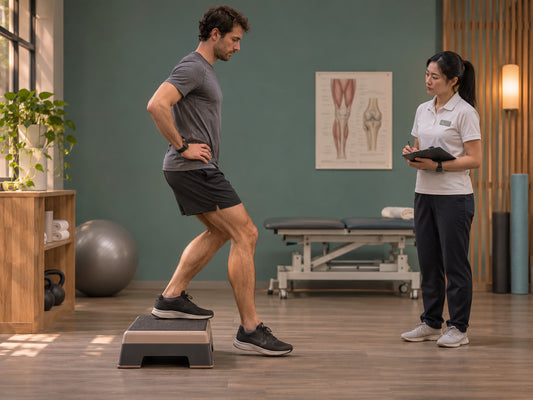
Strength, balance and your ability to sense and control ankle position can remain impaired after a sprain. Targeted rehabilitation addresses these deficits, whether or not surgery is eventually needed.

Pain May Have Another Source

Deep pain, swelling or catching may have a different cause from giving way. Cartilage injury, impingement, a loose body or tendon problems deserve assessment. Stabilising one ligament may not relieve every source of pain.

An “ATFL Injury” on a Scan Does Not Determine Treatment

The anterior talofibular ligament is one of the ligaments on the outside of your ankle. Scan findings must be matched to symptoms, examination and goals.

What Should an Assessment Establish?

History: the first sprain, subsequent giving way, pain or catching, sporting demands, previous rehabilitation and surgery.

Examination: laxity, motion, strength, balance, alignment and other painful structures.

Imaging: bring original images and reports. Additional tests are selected when clinically indicated.

Arthroscopy can reveal detail during a procedure, but is not required for every person with repeated sprains.

Different Ligament Injuries Need Different Considerations

Hou and colleagues described laxity, partial tears, complete tears and ligament defects in 315 selected surgical patients with chronic instability. A ligament may remain continuous yet be too lax to provide normal support. Injury location and usable tissue help guide treatment. This cohort does not show how common each pattern is among all ankle sprains.

Partial Tear: Some Fibres Remain

Some tissue remains continuous. Injury may involve the fibular attachment, ligament body or talar attachment. A partial tear is not automatically an indication for surgery or one particular repair.

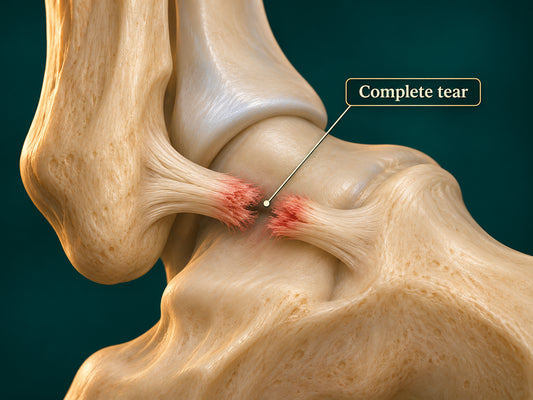
Complete Tear: Continuity Is Lost

A complete tear can also occur at different sites. Repair feasibility depends on remaining tissue, attachment, chronicity and associated injuries—not the word “complete” alone.

Insufficient Tissue for Reliable Repair

When the remaining tissue cannot support a dependable repair, discussion may include local tissue transfer or tendon-graft reconstruction. These have different tissue and fixation requirements.

Further Rehabilitation or a Surgical Assessment?

Review rehabilitation if treatment mainly involved rest or has not adequately addressed strength, balance and movement control. Bracing and activity adjustment may help but do not replace rehabilitation.

Discuss surgery when repeated giving way and activity limitations persist despite appropriate care and assessment identifies a treatable structural problem. Ask which symptoms the operation is expected to improve and which may remain.

What counts as an adequate rehabilitation trial?

Repair, Augmentation, Transfer or Reconstruction?

Persistent giving way despite appropriate rehabilitation may justify a surgical assessment. Usable tissue, injury site, associated lesions and previous surgery help determine the approach.

Repair Existing Ligament

Repair preserves and sutures or reattaches usable tissue. JUMSA repair approaches vary with injury location and tissue condition; the same repair is not appropriate for every tear.

Add Suture or Suture-Tape Support

These use different materials and configurations. Additional support does not replace tissue healing, guarantee earlier sport or turn inadequate tissue into a reliable repair.

Use Suitable Local Tissue

An approach studied by Hou and colleagues uses the distal fascicle of the anterior tibiofibular ligament to augment repair. This does not mean removing the entire ligament. Local anatomy and suitability matter.

Reconstruct with a Tendon Graft

A separate tendon graft can provide tissue for reconstruction. Graft source, fixation, bone tunnels, previous surgery and donor-site risks need discussion. This is distinct from suture-tape augmentation.

What Else May Need Attention?

Treat findings that explain your symptoms. Not every abnormality on a scan needs a procedure.

Look Beyond the ATFL

Avulsion fragments: position, attachment, bone quality and stability help guide observation, preservation, fixation or removal.

Talar cartilage and bone: lesion depth, stability and underlying cysts influence surface treatment, bone treatment or reconstruction.

Other painful structures: impingement, loose bodies, peroneal tendons, the calcaneofibular ligament and subtalar region may need assessment when symptoms suggest them.

Explore Persistent Pain

What Does Research by Dr. Hou and Colleagues Tell Us?

A better result on one outcome does not establish superiority across pain, stability, satisfaction and long-term recovery.

Compare Outcomes and Their Limits

100-patient matched comparison: modified suture augmentation had a higher AOFAS ankle score than suture-anchor repair at about two years, without a significant difference in pain or anterior drawer testing. Read the study.

50-patient matched comparison: modified augmentation had a higher AOFAS score than InternalBrace, while satisfaction favoured InternalBrace; pain and anterior drawer findings did not differ significantly. Read the study.

Local transfer: a 25-patient comparison reported promising early outcomes, but cannot establish the best approach for everyone. Read the study.

Small or retrospective studies have selection bias and limited follow-up. Cadaver strength tests do not measure living tissue healing. Findings are not an individual success-rate prediction.

Recovery Requires Both Healing and Rehabilitation

Risks can include infection, wound problems, nerve symptoms, stiffness, persistent pain, recurrent instability and further surgery. Grafts, implants and accompanying bone or cartilage procedures add their own considerations.

Protect Healing Tissue

Follow the prescribed brace or boot, movement and weight-bearing restrictions. Before overseas travel, agree on wound checks, follow-up, journey timing and who will manage problems locally.

Rebuild Strength and Control

Rehabilitation gradually restores motion, strength, balance and confidence as healing allows. Obtain a written plan your local therapist can follow after returning home.

Return to Activity by Function

Readiness depends on symptoms, swelling, motion, strength, balance and activity-specific function. A calendar date, strong laboratory construct or reassuring scan alone does not establish readiness.

Questions to Ask Before Choosing Treatment

Does a tear on MRI mean I need surgery?

Can suture tape make recovery faster?

Does ongoing pain mean a repair has failed?

How can an overseas assessment help?

References and further reading

Prepare These Records for Further Assessment

  • Symptoms, duration, and activity limitations.
  • Existing imaging reports and original images, if available.
  • Previous treatments and operation records.
  • Rehabilitation history and current medical conditions.
  • Your goals and access to follow-up care at home.

Ask About Assessment for Repeated Ankle Sprains & Chronic Ankle Instability

Your initial inquiry is free and covers your main concerns and the service process; it does not include a medical diagnosis. Coordinating a case review or matching you with a physician involves a service fee. A physician video consultation is charged separately. Charges, required records and arrangements are explained before the service begins.

Dr. Huige Hou can participate in case review or video consultation, subject to record review and scheduling. For the first inquiry, briefly describe your concern without submitting identity documents or a full medical record. Instructions for providing records can follow if a formal review is arranged.

For your initial inquiry, describe the frequency of giving way, your main activity limits and the rehabilitation you have tried.