
Positive Margins After Lumpectomy: Do I Need a Mastectomy?

PATIENT GUIDE
Does a positive margin mean I must lose my breast?
No. A positive margin after lumpectomy does not automatically mean you need a mastectomy. Often, the next step is a smaller repeat operation, called re-excision, to remove more tissue around the affected edge. Whether that is suitable depends on the complete pathology result and how much breast tissue remains. American Cancer Society: what happens next.
A positive margin means cancer cells reach an edge of the tissue that was removed. It raises concern that cells may remain in the breast; it does not, by itself, tell you that cancer has spread elsewhere. ASBrS margin guidance.
Ask your breast team to review the report with you before deciding on another operation. Keep existing appointments while arranging a review or second opinion. You do not have to interpret the report alone.
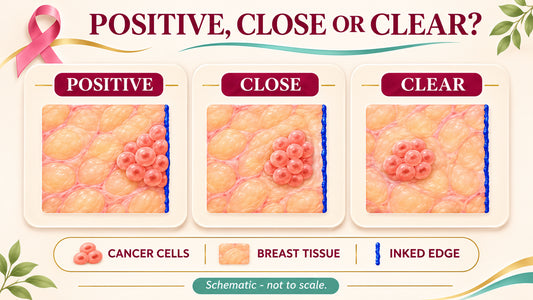
What is the difference between positive, close and clear?
The laboratory examines the edges of the removed tissue under a microscope. “Positive” means cells reach an edge. “Negative” or “clear” means they do not. A “close” result describes a small distance from the cancer to an edge; it is not the same as a positive result. ACS explanation.
For invasive breast cancer treated with whole-breast radiotherapy: the usual standard is no cancer touching the ink marking the specimen edge. A wider clear margin is not routinely needed, including when invasive cancer has a DCIS component. ASBrS guidance.
For pure DCIS treated with whole-breast radiotherapy: 2 mm is the usual adequate margin standard. DCIS means abnormal cells remain within the breast ducts. A negative margin under 2 mm is not, on its own, a reason for mastectomy; the team weighs whether another excision would help. SSO–ASTRO–ASCO DCIS guideline.
Ask which cancer type and radiotherapy plan the margin recommendation assumes. These numbers are not a universal rule for every treatment setting.

When is re-excision possible, and when might mastectomy help?
Re-excision may preserve the breast when the affected area can be removed with clear margins and an acceptable breast shape. The amount and location of remaining disease, imaging findings, breast size and your preferences all matter. Oncoplastic surgery combines cancer removal with reshaping and may expand options for selected patients. ASBrS breast-conservation guide.
Mastectomy may be recommended when margins remain positive despite further excision, suspicious or malignant calcifications are spread widely, or all the disease cannot be removed while preserving the breast. Previous radiation or difficulty receiving planned radiation can also change the discussion. ASBrS: suitability and limits.
Further breast surgery can bring pain, bleeding, infection, fluid buildup and changes in shape. Ask about recovery and reconstruction before choosing. ACS: possible side effects.
Most positive margins need further excision. There are exceptions: an involved edge next to skin or chest muscle may need different management if no breast tissue remains there and the operative findings support this. Your surgeon and multidisciplinary team should explain and document any decision not to re-excise. ASBrS: exceptions.
Radiotherapy should be discussed as part of the complete plan; do not assume it can simply replace surgery for a positive margin. A recommendation should explain both the cancer-control goal and the expected effect on your daily life. ASBrS margin guidance.
Can newer technology prevent a second operation?
Better guidance can help surgeons, but it cannot guarantee a clear margin. A randomized study published on 22 October 2026 compared an MRI-based guidance system with wire localization in 418 patients whose cancers could not be felt and were visible on MRI. Positive margins occurred in 14.4% and 21.1%, respectively. Read the original trial.
The study met its predefined test for being no worse, but narrowly missed its stricter primary test for superiority. It studied how the first operation was guided, not whether someone with a positive margin should choose re-excision or mastectomy. It also does not show that this device is used by Professor Su.
The useful question is: “Which assessment methods fit my cancer, and what is the plan if the final laboratory result differs from what we knew during surgery?”

What should I bring and ask at my surgical review?
Bring the final pathology report, operation report, breast imaging reports and your proposed treatment plan. If seeking another opinion, ask the receiving team whether original images or pathology slides are needed.
1. Is the margin positive or only close, and which edge or edges are involved?
2. How much additional tissue would you remove, and could reshaping help?
3. Why is re-excision or mastectomy recommended for me? What are the alternatives and their risks?
4. How will this affect radiotherapy, other treatment and the timing of my next appointment?
Professor Fengxi Su has coauthored research on cavity-margin assessment. In a 2019 randomized trial of 181 patients, researchers tested removing an additional rim of tissue around the lumpectomy cavity. Overall reductions in positive margins and second operations were not statistically significant. This supports a careful, case-specific discussion rather than a promise that one technique prevents further surgery.
Explore Professor Su’s areas of practice or the patient guide to surgical-margin assessment. For consultation arrangements, tell medChina your main question. The team can explain how to share existing reports through an appropriate channel; the initial contact form does not accept report uploads.
You can ask for a clear explanation and a written next-step plan. Continue care with your treating team while any additional opinion is arranged.
Sources and editorial information
Prepared by the medChina editorial team. Sources checked on 3 November 2026.
References: ACS patient information (2026); ASBrS margin guidance (2024); ASBrS breast-conservation guide (2026); SSO–ASTRO–ASCO DCIS guideline (2016); MRI guidance trial (2026); Su coauthored cavity-shaving trial (2019).
Illustrative scenes, not records of actual patient care.
This guide explains general options after a lumpectomy result. It cannot determine which operation is right for you; your treating team must review your complete clinical findings.