
Can Frozen Section Testing During Lumpectomy Help Avoid a Second Operation?
PATIENT GUIDE
Can margins be checked while I am still in surgery?
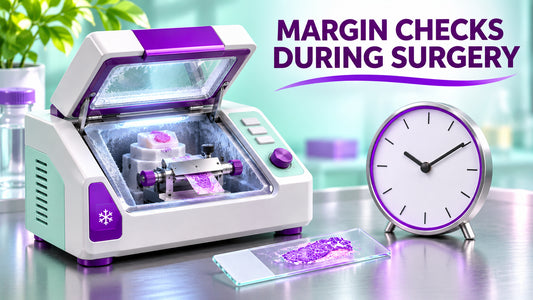
Yes. In some hospitals, a pathologist examines frozen tissue sections while lumpectomy is under way. If cancer is found at an assessed margin, the surgeon may remove more tissue during the same operation. This can help avoid a later return to surgery, but a negative frozen result is not a guarantee: permanent pathology must still confirm it.
A margin is the edge of tissue removed with the cancer, or tissue sampled from the walls of the space left behind. Frozen section describes how tissue is prepared for rapid microscopic examination; it is not a treatment that freezes cancer inside the breast.
The practical question is whether this test would change your operation safely—not whether every hospital uses it. Discuss the plan with your treating surgeon before surgery.

What does Professor Su’s research actually show?
A 2012 study coauthored by Professor Fengxi Su retrospectively reviewed 422 patients who had breast-conserving surgery with intraoperative cavity-margin assessment. The team examined frozen samples taken around the surgical cavity.
The reported second-operation rate due to false-negative frozen-section findings was 3.5%. That means some patients still needed another operation even after rapid testing. The study was not randomized and did not establish how much this method improves outcomes over every alternative.
This is evidence of research into margin assessment, not a personal success-rate promise or proof of current availability for your case. Ask the team which approach they use now. Su’s breast-conservation and oncoplastic expertise is relevant to discussing both clearance and breast shape.

Why do I still need the final pathology report?
Rapid frozen sections examine selected tissue during the operation. The later permanent sections use a different preparation process and may reveal cancer that was missed on the rapid assessment. Frozen interpretation can also be falsely positive. This is why the final report remains essential.
Ask when your permanent results are expected and who will explain them. Do not interpret an encouraging comment after surgery as the final margin result. If the report identifies a positive margin, the next decision depends on the full findings and your treatment plan.
A separate guide explains the choices after a positive final margin. Frozen testing does not replace that discussion, radiation planning, or other recommended treatment.
Who might benefit—and what are the trade-offs?
This is worth discussing when you are already a candidate for lumpectomy and the hospital has an experienced team able to examine margins during surgery. Availability, the tissue being assessed and how the result would change the operation all matter.
It does not make breast conservation appropriate when your overall cancer findings make that operation unsuitable. Nor should you assume that it can reliably rule out all remaining disease. A separate observational study found that lobular cancer, multifocal disease and larger tumors were associated with failure of frozen margin assessment to prevent another operation.
Trade-offs include time and pathology resources during the operation, an incorrect rapid result, and potentially removing additional breast tissue. Ask how the team balances margin clearance with breast appearance and whether an oncoplastic plan changes later options.
An alternative is to await permanent pathology and perform further surgery if indicated. Teams may also use specimen imaging or additional cavity samples; these answer different questions and are not automatically equivalent to frozen microscopic examination. Ask which combination is appropriate for you.
Jorns and colleagues: observational comparison and limitations

What should I ask before my operation?
Bring your biopsy report, breast imaging reports and images, previous surgery or treatment details, and a list of your priorities. Ask: Will you assess margins during surgery? Is that frozen section, imaging, additional cavity samples, or a combination?
Then ask: What would you do if a rapid result were positive or uncertain? How much extra tissue might be removed? How could that affect breast shape? What happens if the final report disagrees? When will I receive that report?
Ask for the team’s experience in patients similar to you rather than assuming a published percentage predicts your outcome. If you are considering consultation with Professor Su’s team, use the contact page for an initial enquiry. The team can explain how to submit records separately; the initial form does not offer a medical-record upload.
Keep your established care moving while you clarify these questions. Choosing a margin-assessment method is one part of a broader treatment decision.
Sources and editorial note
Prepared by the medChina Editorial Team. Evidence checked on 6 November 2026. This educational article was not written or medically reviewed by Professor Su. Individual recommendations require your treating team’s assessment.
The 2012 papers below describe historical techniques and selected patient groups. Their findings do not establish a current individual reoperation rate. The older study’s surgical protocol should not be used as a universal margin-width recommendation.
Illustrative scenes, not records of actual patient care.
2. Susan G. Komen. Preserving breast tissue samples.