


Ovarian Cancer Treatment in China: Options, Costs & Assessment

Understand your options before you travel

Explore ovarian cancer treatment in China, the information needed to assess your options, and the full costs to consider before travelling.

This guide focuses on epithelial ovarian, fallopian tube and primary peritoneal cancers. Rare tumour types need separate specialist advice.

Start a Free Inquiry

No payment or complete medical file is needed to begin. We will explain the process and which next steps involve a fee.

Initial guidance is non-clinical. Records coordination and specialist matching are paid services; doctor consultations, when available, are charged separately.

Could an Assessment in China Help You?

Specialist centres in China use established treatment approaches and participate in clinical research. The relevant question is which option, if any, fits your individual situation. This page does not confirm access to a particular hospital or doctor.

Could a specialist surgical assessment help?

A specialist review can clarify whether complex surgery is feasible, what complete visible tumour removal might involve and whether the risks are acceptable. A further opinion may also confirm your current plan.

Could China offer a relevant treatment option?

Compare options against your cancer type, previous treatment and biomarkers. A medicine being approved in China does not establish individual eligibility or confirm that a particular hospital can supply it.

Would the total cost make sense for me?

Compare assessment, treatment, medicines, coordination, travel and follow-up together. A lower procedure price does not necessarily mean a lower total cost, particularly if care at home is insured.

Is an overseas assessment worth the journey?

Clarify the purpose of the assessment before booking travel. Equivalent care may already be available locally, and your treating clinician should advise whether travel or any delay is safe.

What Information Determines Your Treatment Options?

Newly diagnosed, advanced and recurrent ovarian cancers can require different decisions. Pathology, disease distribution, biomarkers, previous treatment and your health should be considered together.

What type of ovarian cancer do I have?

Pathology establishes the tumour type. High-grade serous, low-grade serous, clear-cell and other ovarian tumours may require different treatment discussions. Review may clarify uncertain findings; it does not always change the diagnosis.

Where is the disease, and could surgery help?

Imaging, symptoms and previous operation findings help assess disease distribution and surgical feasibility. Existing scans should be reviewed before deciding whether further imaging is needed.

Which biomarker tests could change my options?

BRCA and HRD results can inform some maintenance decisions; FRα testing may identify eligibility for a specific ADC. Testing should answer a clinical question. A positive result does not guarantee benefit.

What do my previous treatments and health tell us?

Drug names, dates, response, side effects, other conditions and your priorities all matter. Rare tumours and fertility concerns need their own specialist discussion. A stage number alone cannot select treatment.

Ovarian Cancer Treatment Options to Discuss

These options are not interchangeable and are not appropriate for every patient. A clinician must confirm the indication, expected benefit, risks and actual availability. Research treatments are not routine care.

Could cytoreductive surgery be appropriate?

The aim is to remove visible tumour where this can be achieved with acceptable risk. Complex disease may require bowel, peritoneal or upper-abdominal procedures. Ask about complications, possible stoma and recovery. No visible residual disease does not guarantee cure.

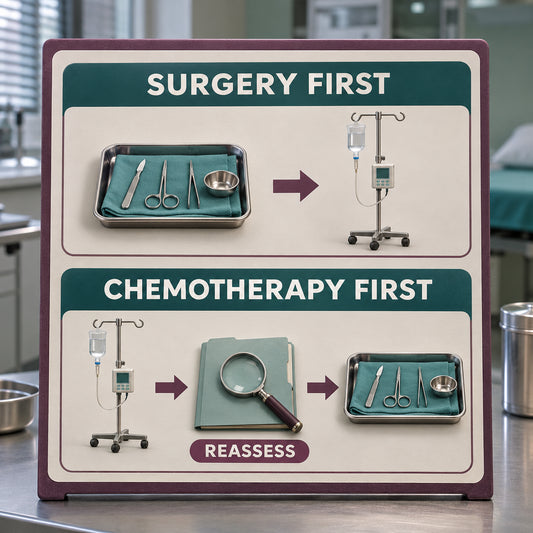
Should chemotherapy or surgery come first?

Some patients benefit from chemotherapy before reassessment for interval surgery. This can be a planned approach when immediate complete removal is unlikely or surgical risk is high. Treatment order requires specialist assessment.

How is chemotherapy selected and monitored?

Platinum-based chemotherapy is central to many treatment pathways. Drug choice and scheduling depend on tumour type, treatment setting, previous response and tolerance. Monitoring helps manage side effects and decide whether treatment should change.

Could maintenance treatment help after chemotherapy?

After a response, selected patients may be offered a PARP inhibitor or another suitable maintenance strategy. Biomarkers, prior treatment and the applicable drug indication matter. Monitoring continues; maintenance does not guarantee prevention of recurrence.

Could an antibody–drug conjugate be an option?

Mirvetuximab soravtansine may be considered for certain FRα-positive, platinum-resistant cancers after prior treatment. Testing, the current indication and clinical suitability must be confirmed. Eye-related adverse effects require particular attention.

What about anti-angiogenic or immune treatment?

Anti-angiogenic medicines and selected immune approaches have different indications and risks. China has a suvemcitug-with-chemotherapy indication for a defined platinum-resistant setting. Eligibility, supply and monitoring need confirmation; these are not universal treatments.

When might HIPEC be discussed?

HIPEC circulates heated chemotherapy in the abdomen during surgery. It is considered only in selected settings; international recommendations differ. Discuss additional risks, kidney function, the surgical plan and the centre's experience.

Are there relevant clinical trials in China?

Studies may investigate new medicines or combinations. The study team determines eligibility and must confirm recruitment, international-patient acceptance, visits and costs. A published trial is not an available appointment, and participation does not guarantee benefit.

Recurrent, Platinum-Resistant or Complex Disease

A difficult treatment history deserves an individual review. An additional opinion can identify missing information or confirm that the current plan remains appropriate.

My cancer has returned. What should be reassessed?

A new review considers the location of recurrence, time since treatment, previous response, symptoms and overall health. Further medicines, selected surgery or research may be discussed; another operation is not appropriate for everyone.

The cancer progressed during or after platinum treatment.

Bring the full treatment timeline. Non-platinum options, relevant biomarkers and suitable studies may be considered according to current guidance. Symptom control and tolerance remain central to the decision.

What if treatment stopped working after a PARP inhibitor?

Record the medicine, duration, response and reason for stopping. Progression does not automatically make another PARP inhibitor appropriate. The next step depends on prior treatments, current findings and available evidence.

I was told surgery is not possible. Can I seek another view?

A further assessment may clarify the reasons and the information still needed. It may also confirm that surgery is unsafe or unlikely to help. An additional opinion cannot guarantee an operation or justify delaying necessary local care.

Benefits, Risks and Life During Treatment

A useful assessment explains realistic goals, uncertainty, potential complications and how treatment may affect daily life.

What would a meaningful treatment benefit look like?

Ask whether the goal is removing visible disease, delaying progression, relieving symptoms or another outcome. Tumour shrinkage, progression-free survival and overall survival are different measures; study averages cannot predict one person's result.

What risks and recovery needs should I prepare for?

Discuss complications, hospital time, possible additional procedures and support at home. Plans may change during treatment. Ask which symptoms require urgent local medical care and who is responsible for follow-up.

How can care support my everyday life?

Pain relief, nutrition, fatigue management, emotional support and sexual health deserve attention alongside cancer treatment. Supportive and palliative care can accompany active treatment. Ask what is available locally and at the receiving hospital.

Costs, Free Enquiries and Paid Services

There is no single ovarian cancer treatment price. Compare a written, case-specific estimate with the total cost of travel and continuing care. No unverified price range or promised saving is presented here.

What will assessment and testing cost?

An estimate may include specialist assessment, pathology review, imaging and clinically necessary molecular tests. Ask which existing overseas results can be used and which additional tests are required before accepting a quote.

What changes the hospital treatment estimate?

Surgery, anaesthesia, medicines, ward type, length of stay and complications can affect the total. Request a dated estimate with inclusions, exclusions and payment terms. No verified individual treatment price is available before assessment.

What should I budget beyond the hospital?

Include flights, accommodation, a companion, interpretation, local transport and possible extended stays. Continuing medicines and tests at home also matter. China is not necessarily cheaper for every patient or insurance situation.

What does the free initial enquiry include?

Start by describing your situation and questions. The initial enquiry explains the process and is non-clinical; it is not a doctor's diagnosis or a formal medical second opinion. No complete medical file is needed to begin.

When does specialist matching become a paid service?

Medical-record preparation and specialist matching are paid services. Before purchasing, confirm the fee, deliverables, exclusions, cancellation terms and what happens if no suitable appointment can be arranged. Payment does not guarantee acceptance.

Is a doctor's video consultation charged separately?

Yes. If a suitable doctor accepts a remote consultation, it carries a separate fee. Confirm the format, language, duration, written output and cancellation terms before booking. Availability must be checked; hospital treatment is separate.

Planning Care Before, During and After Travel

Medical suitability, provider acceptance and practical arrangements should be confirmed before you commit to travel. Interpretation, transport and accommodation are not automatically included.

What should be confirmed before I travel?

Clarify the purpose of assessment, provider acceptance, appointment, records, costs and language support. Discuss travel fitness with your treating clinician. Do not delay time-sensitive care or book non-refundable travel for an unconfirmed appointment.

Who will help while I am in China?

Confirm who handles appointments, interpretation, payment questions and medical problems. The treating institution is responsible for clinical care. Platform coordination and hospital services should have clearly agreed scopes.

How will treatment continue after I return home?

Plan treatment summaries, prescriptions, monitoring and communication with local clinicians. Check medicine availability before starting an ongoing treatment. Remote coordination does not replace local emergency or follow-up care.

Questions International Patients Often Ask

Understand what can be assessed, what must still be confirmed and how to make an informed decision without pressure.

Can I ask for an opinion without committing to travel?

Yes, you can start with an enquiry. Whether a clinician can provide a remote assessment must be confirmed. Another opinion may clarify or confirm the current plan rather than recommend different treatment.

Can you guarantee a named specialist or trial place?

No. Clinicians, hospitals and study teams decide acceptance and eligibility. This guide describes treatment areas, not a roster of contracted doctors. Matching or coordination fees do not purchase a clinical trial place.

Which records should I prepare, and will tests be repeated?

Prepare pathology, imaging, operation reports, treatment dates, medicines and existing biomarker results. Existing evidence should be reviewed first; additional tests depend on what is missing or clinically needed. Ask before shipping original tissue.

How should I share medical information?

Begin with a brief enquiry. Read the Privacy Policy and confirm the receiving organisation, purpose and transfer method before sending a detailed file. A first enquiry is not blanket permission to share records with hospitals.

What if I cannot proceed after paying for a service?

Ask for the applicable cancellation and refund terms before payment, including what happens if no suitable appointment is found. Insurance reimbursement and written consultation reports must also be confirmed; they are not automatic.

How can I check the information in this guide?

Consult the linked guidance and primary research below. Evidence for a technique is separate from availability at a hospital. Illustrations are AI-generated educational scenes, not real clinicians, patients, hospitals or treatment outcomes.

Start Your Free Ovarian Cancer Enquiry

Start with your question and where you live. You may also tell us your preferred language and whether you are the patient or a family member.

No payment or complete medical file is needed. We will explain the process and any proposed paid service before you decide whether to continue.

Please do not send passport details or full medical records here. Read our Privacy Policy. This form is for non-emergency inquiries.

Evidence and service transparency

This educational guide is prepared by medChina.global and does not replace clinical advice. Treatment evidence does not establish an appointment, hospital supply or individual eligibility. No named clinician or hospital partnership is represented here.

Selected references: Chinese national ovarian cancer guidance (2022); ASCO neoadjuvant chemotherapy guideline update (2025); ESMO ovarian cancer update (2026); NCI ovarian cancer treatment summary; SOC-1 recurrent ovarian cancer surgery trial; Understanding clinical studies.

China medicine information: mirvetuximab application material; suvemcitug application material. These published reimbursement application materials do not replace the current prescribing label or hospital confirmation.

Content prepared: 8 November 2026. Images are AI-generated educational illustrations, not real doctors, patients, hospitals or treatment outcomes. This enquiry service is not for emergencies; seek local urgent care for urgent medical problems.