
Can I Have a Second Lumpectomy After Breast Cancer Returns?

PATIENT GUIDE
Is mastectomy the only option after a local recurrence?
Sometimes a second lumpectomy is possible. For selected people whose cancer returns in the same breast after lumpectomy and radiotherapy, another breast-conserving operation followed by carefully planned partial breast reirradiation may be an option. Mastectomy remains the usual treatment, and suitability needs joint surgical and radiation-oncology review.
This guide concerns a confirmed cancer confined to the previously treated breast, including a new cancer arising there. It is different from an early second operation to clear a positive margin, cancer in the opposite breast, or cancer that has spread to distant organs. American Cancer Society: treating recurrence.
“Reirradiation” means giving radiation again, usually to a limited part of the breast in this setting. It is not simply repeating the first course. The 2026 AGO recommendations support considering this approach when the recurrence has favourable features. The possibility offers another discussion to have, not a guarantee that breast preservation will be safe for you.
What must the team check before offering another lumpectomy?
First confirm what the new finding is and how far it extends. A new lump or scan change is not automatically cancer. Ask whether a new biopsy, receptor testing and comparison with the original pathology are needed. Imaging and, when indicated, staging tests help distinguish local disease from spread elsewhere. NCI: diagnosis and treatment of recurrence. AGO: staging before treatment.
Repeat conservation is more plausible when the area is small and localised, the surgeon can remove it with clear margins while leaving an acceptable breast, and the radiation oncologist can design a suitable second radiation course. The interval since the first cancer, previous dose and treatment area, existing tissue damage, tumour biology and your preferences all matter. Dutch breast cancer guideline, updated June 2026.
More extensive disease, skin or chest-wall involvement, inability to obtain clear margins, or a breast that cannot safely receive further radiation may make mastectomy more appropriate. Different protocols use different size and time-interval criteria; an online cut-off cannot decide eligibility.
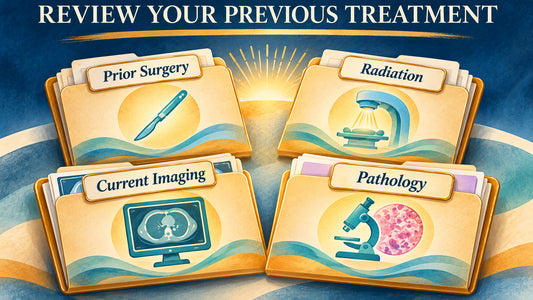
Bring the original radiotherapy treatment summary and, if obtainable through your treatment centre, the detailed plan and dose records. Knowing only that you “had radiation” is not enough for this assessment.

How should I compare the risks and alternatives?
Repeat surgery and radiation can change breast shape, firmness and comfort. Discuss persistent pain, skin changes, scarring or fibrosis, wound-healing problems and the possibility of later mastectomy. The RTOG study included later mastectomies for non-healing wounds as well as further cancer. RTOG 1014: outcomes and adverse effects.
A second lumpectomy alone is not the same treatment as lumpectomy plus reirradiation. If further radiation is not feasible or you do not want it, ask how that changes local cancer control and the recommendation. Dutch guideline: repeat conservation and radiation.
Mastectomy removes the breast and may be discussed with reconstruction or without reconstruction. Ask about recovery, sensation, wound risk after previous radiation, an external breast form and a flat closure if preferred. Your surgical team should explain which choices are feasible for you. American Cancer Society: local recurrence treatment.
Either operation may still need drug treatment. Hormone therapy, chemotherapy or targeted treatment decisions depend on the new cancer's biology and your prior treatment; removing the breast does not settle every part of the treatment plan. AGO: treatment after local recurrence.
What does the prospective study show?
The NRG/RTOG 1014 phase 2 study evaluated 58 women after a second lumpectomy and partial breast reirradiation. Participants were carefully selected: disease was limited to one area, margins were negative and most tumours measured 2 cm or less. Read the original study.
At five years, the estimated chance of another cancer event in that breast was about 5% (95% confidence interval, 1%–13%); the estimated chance of a subsequent mastectomy was about 10%. Severe late treatment effects, called grade 3, occurred in 7%; no grade 4 or 5 late effects were reported.
This small study had no randomised mastectomy comparison. It cannot prove equal survival or predict your outcome, especially if your situation differs from the selected participants.
The 2026 Dutch guideline also rates the comparative evidence as very uncertain. Ask what evidence best matches your tumour, previous treatment and proposed radiation technique.

What should I bring and ask at a consultation?
Bring the original operation and pathology reports, radiotherapy records, current biopsy and receptor results, recent breast imaging, current medicines and any relevant genetic-test result. Note persistent pain, skin tightness or wound problems from the first treatment.
Ask five practical questions: Is the cancer truly localised? Can we obtain clear margins and a breast shape I can accept? Can further radiation be delivered safely, and by which team? How do the chances of another operation and lasting side effects compare with mastectomy? What is the treatment timetable?
Professor Fengxi Su's verified areas of work include breast-conservation assessment, oncoplastic surgery and reconstruction, sentinel-node and axillary management, and margin assessment. He is a coauthor of the 2021 CSBrS breast-conserving surgery guideline. That does not imply he authored the repeat-irradiation trial or that every patient can receive this treatment. Learn about Professor Su's approach.
A recurrence discussion needs the appropriate multidisciplinary team, including a radiation oncologist when further radiation is being considered. You can contact the medChina team to ask about assessment; the team will explain how to submit records separately. Keep scheduled care and agreed treatment moving while seeking another opinion.
Sources and editorial note
1. American Cancer Society — Treatment of recurrent breast cancer (revised 9 July 2026).
2. National Cancer Institute — Recurrent breast cancer.
3. AGO recommendations for early breast cancer, 2026 update — locoregional recurrence section.
4. Dutch breast cancer guideline — Local treatment after previous breast conservation (17 June 2026; Dutch).
5. Arthur et al. — NRG/RTOG 1014 phase 2 clinical trial. JAMA Oncology, 2020; published online 21 November 2019. DOI: 10.1001/jamaoncol.2019.4320.
6. Chen et al. — CSBrS breast-conserving surgery guideline, 2021 (FengXi Su, coauthor).
Prepared by the medChina Editorial Team. Sources checked 4 November 2026. General education to support a discussion with your treating team; individual recommendations require clinical assessment.
Illustrative scenes, not records of actual patient care.