
Radiotherapy Delayed Because My Wound Has Not Healed: What Now?
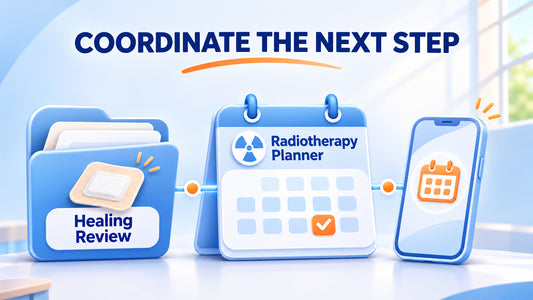
PATIENT GUIDE
My wound has not healed. What happens to radiotherapy?
Tell both your surgical team and radiation oncology team promptly. Ask them to agree a wound-review date and a treatment plan. A healing problem may change the start date, but it should not leave you without a clear next step.
Radiotherapy can slow wound healing. NCI explains that treatment commonly begins after a recovery interval following surgery; the timing also depends on other planned treatments. NCI: radiation for breast cancer
Do not decide for yourself that a wound is ready, or cancel radiotherapy permanently because one appointment is postponed. The teams need to assess healing alongside the reason radiation was recommended.

Is every later start an unexpected delay?
No. If chemotherapy is given after surgery, radiotherapy usually follows chemotherapy. That planned sequence differs from waiting because a wound is not healing or because an appointment has not been arranged. Breast Cancer Now: treatment sequence
A seroma, a collection of fluid after surgery, may also affect timing. Ask whether the issue is an open wound, infection, fluid collection, arm movement, treatment sequencing or scheduling. These problems need different responses.
Patient information pages describe typical intervals, not a personal deadline or a guarantee that waiting is harmless. Your team should explain how its proposed date fits your cancer and current recovery.
Record the dates of surgery, any further operation and the last chemotherapy treatment. When asking about timing, make clear which event you are counting from.

What needs to be assessed before treatment starts?
Royal Free London advises that the surgical wound should be healed and a seroma settled before external-beam treatment begins. Tell the radiation team about ongoing healing problems when the planning appointment is arranged. Royal Free: preparing for radiotherapy
Let them know if it is difficult to hold the required arm position. The team can assess positioning and whether rehabilitation support is needed; do not force a painful movement to meet a date.
Ask who will confirm readiness: the surgeon, wound-care service, radiation oncologist or a coordinated review. Also ask what findings they need to see before the plan can progress.
A planning scan and the first treatment are different appointments. Ask whether the planning appointment should proceed and whether a change in swelling or wound condition could affect the plan. Follow the department’s instructions rather than assuming.
How does Professor Su’s seroma research fit this question?
A 2017 study co-authored by Fengxi Su compared two agents used during axillary lymph-node surgery, Sapylin and Avitene, with a control group. The study randomly allocated 224 patients and measured drainage and seroma-related outcomes. Original study, PMID 28457344
Both treated groups had shorter drainage duration than controls. The research concerns attempts to reduce postoperative fluid problems in a specific surgical setting.
It did not establish a safe waiting interval for radiotherapy, test treatment of an already open wound at home, or prove that either product should be used for your current problem.
The relevance is limited: postoperative recovery problems are studied because they matter to care. Your existing wound or seroma still needs assessment by the treating team; do not seek these products as a way to bring forward radiation.

What should I do while the plan is being reviewed?
Follow the dressing and wound-care plan, and keep the arranged reviews. Contact your surgical team immediately for increasing warmth, redness or other colour change, swelling, discharge, fever, shivering or feeling unwell, especially if infection is suspected. Cancer Research UK: infection after reconstruction
Ask for the next review date, the person coordinating the decision and a contact if healing worsens. If the date passes without an update, contact the service rather than assuming the referral is progressing.
If the wound is ready but the start date remains unclear, ask the radiation department to review the scheduling concern. A medical delay and a booking problem should not be treated as the same explanation.
Ask whether any prescribed systemic treatment continues during the wait. Some treatments can be combined with radiation, but the exact sequence is individual; do not start, stop or substitute medication yourself. NCI: radiation alongside other treatments
A useful question is: “What are we waiting to improve, when will you reassess it, and what is the plan if it has not improved by then?” Bring a companion or take notes so that the agreed steps are clear.
Sources, scope and editorial notes
Prepared by medChina Editorial Team. Sources checked 19 November 2026. General education; this article was not medically reviewed by Professor Su.
Treatment timing and combinations: National Cancer Institute
Sequence and reasons for postponement: Breast Cancer Now
Readiness for planning and treatment: Royal Free London
Seroma-prevention research: 2017 axillary surgery study
All scenes are illustrative, not actual patients, treatment plans or research results. Calendars do not specify a safe waiting interval, and the academic scene does not imply endorsement.