
Can a MicroRNA Test Replace Oncotype DX in Breast Cancer?
PATIENT GUIDE
Can a microRNA result replace an established recurrence test?
Not on the strength of a research paper alone. A microRNA model may provide useful research information about recurrence risk without having established that using it to choose treatment improves patient outcomes.
Before substituting any assay, ask your oncologist to identify the exact test and the evidence for its intended use in your situation. A label such as “gene test” or “recurrence score” does not make different assays interchangeable.
ASCO’s guidance supports named assays for defined early breast cancer populations and decisions. It does not endorse the 10-microRNA research classifier discussed here as a replacement for those assays. ASCO biomarker guideline
What are microRNAs, and what is a signature?
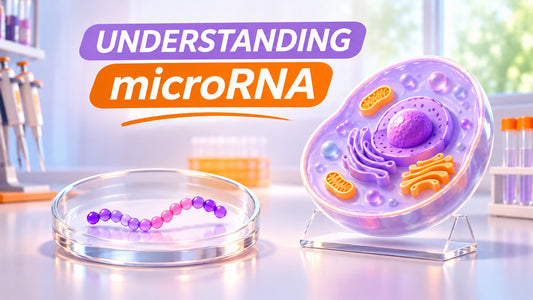
MicroRNAs, often shortened to miRNAs, are small RNA molecules that help regulate gene expression. They are being studied in cancer diagnosis and treatment. NCI definition
A signature combines measurements into a pattern or score. The clinical meaning depends on which molecules are measured, how the sample is processed and how the score was developed.
Tumour-marker tests can serve different purposes, including estimating prognosis, helping select treatment or monitoring disease. Evidence for one purpose should not automatically be transferred to another. NCI: tumour-marker uses
The bead strands shown here are a visual metaphor, not the structure of a specific microRNA or an illustration of a test result.

What did Professor Su’s microRNA study show?
A 2016 study co-authored by Fengxi Su developed a 10-microRNA classifier in hormone receptor-positive, HER2-negative breast cancer. It used 202 training samples, 101 internal-validation samples and 308 external-validation samples. Original research paper
The retrospective analysis linked the classifier to distant relapse-free survival. Its comparison with a 21-gene score involved 153 node-negative cases and used the Surexam assay named in the methods.
That is not a direct demonstration that the classifier is superior to the branded Oncotype DX test. A shared number of genes does not establish assay equivalence.
The authors acknowledged the retrospective design and called for prospective randomized validation, further treatment-benefit evaluation and assessment in other populations. The paper does not establish that acting on this classifier can safely replace guideline-supported treatment decisions.
Why is predicting recurrence different from choosing chemotherapy?
A prognostic marker estimates how outcomes vary between groups. A treatment-predictive marker helps identify whether the benefit of a particular treatment differs. A test can have prognostic value without proving how it should change treatment. Different roles of tumour markers
Observing better outcomes among people who received a treatment is not the same as randomly assigning treatment according to a test. Differences in the patients and their care can affect the comparison.
In practice, your oncology team needs evidence that matches the decision being considered: adding chemotherapy, extending endocrine therapy or another specific action. One score does not answer all of these questions.
Even established assays have eligibility limits. ASCO distinguishes patients by menopausal status, lymph-node involvement and tumour subtype; recommendations should not be generalized to every breast cancer. Population-specific recommendations
Do not interpret a research “low-risk” label as permission to stop endocrine treatment, skip chemotherapy or reduce follow-up on your own.

What should I ask before paying for another test?
Start with: “What exact decision could this result change?” Ask what the recommendation would be without the test and how each possible result would alter it.
Request the assay name, laboratory, sample type and intended use. Clarify whether it is a clinical test or research participation, and whether the proposed test is the same method used in the cited evidence.
Ask about validation in people with your cancer subtype and treatment setting. Request the supporting guideline or study rather than relying only on a promotional accuracy claim.
NCI explains that biomarker testing does not always produce useful treatment information. Ask about insufficient samples, inconclusive findings, cost and whether waiting for a result could affect your treatment timetable. Benefits and limitations of biomarker testing
If you already have two different results, give your oncologist both complete reports. Ask them to resolve the discrepancy in the context of your pathology and care plan before ordering another test.
Sources, scope and editorial notes
Prepared by medChina Editorial Team. Sources checked 19 November 2026. General patient education; this article was not medically reviewed by Professor Su.
Research classifier, PMID 27566954: 2016 microRNA study and limitations
Established assay recommendations: ASCO early breast cancer biomarker guideline
What biomarker testing can and cannot provide: National Cancer Institute
The article discusses one research classifier. It does not claim that all microRNA tests have the same evidence, purpose or availability.
All images are illustrative, not actual molecular structures, laboratory results or patient records. The imagined academic scene does not imply endorsement or clinical review.