
Intraductal Papilloma Without Atypia: Do I Need Surgery?

PATIENT GUIDE
Is surgery always necessary?
Not always. Some people with an intraductal papilloma without atypia can discuss planned surveillance after the breast team confirms that the biopsy adequately explains the imaging finding. Others need more tissue removed to clarify the diagnosis or treat symptoms. The words “without atypia” are reassuring, but they do not by themselves settle the decision.
A prospective study of 116 asymptomatic papillomas found DCIS in two excision specimens on local review (1.7%); central review did not confirm those two DCIS diagnoses. Discordant findings and additional lesions requiring removal were excluded. This supports selective management, not a guarantee that any individual papilloma is harmless. TBCRC034 prospective study (2021)
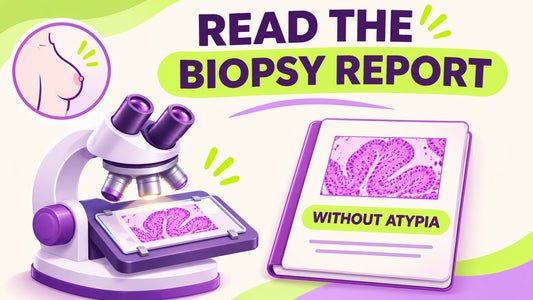
What does the biopsy result actually mean?
A papilloma is a growth inside a breast milk duct. It is different from papillary breast cancer. “Without atypia” means atypical cells were not identified in the sampled tissue. A needle biopsy samples tissue; it may not assess every part of a lesion. Ask whether the radiologist and pathologist agree that the result explains the original abnormality. This agreement is called concordance. TBCRC034 prospective study (2021)Breast Cancer Now: intraductal papilloma
A useful question is: “Is my report a definite benign papilloma without atypia, or does it only say papillary lesion?” Bring the exact report rather than relying on a remembered label.
When should removal be discussed?
A lump, persistent nipple discharge, unexplained imaging findings, or an uncertain biopsy result can change the discussion. Atypia is a different situation from the diagnosis addressed here. Ask your team what additional sampling would resolve and whether the aim is diagnosis, symptom relief, or both. Breast Cancer Now: intraductal papilloma
Recommendations vary by healthcare system. The 2021 Chinese Society of Breast Surgery guideline recommended complete removal of diagnosed papillomas, with the procedure selected according to symptoms and imaging. That older regional recommendation differs from the selective approach supported by the prospective study; it should not be presented as a universal current rule. TBCRC034 prospective study (2021)CSBrS papilloma guideline (2021; regional historical context)
Do not cancel a planned procedure on the basis of this article. Ask the team to explain which feature of your own case drives its recommendation.
Professor Fengxi Su coauthored a study of 1,578 patients following ultrasound-guided vacuum-assisted excision of benign breast disease. It examined recurrence and associated factors. This is relevant background in benign breast lesion management; it does not prove that a particular papilloma can safely avoid surgery. Li et al., coauthored by Fengxi Su: benign breast lesion excision (2013)
What are the alternatives to an operation?
The discussion may include planned follow-up, vacuum-assisted removal, or surgical excision. Vacuum-assisted removal uses an image-guided device through a small skin opening; surgical excision removes tissue through an incision. The team must decide whether a less invasive approach can adequately assess the particular lesion. CSBrS papilloma guideline (2021; regional historical context)NHS: vacuum-assisted excision and procedural risks
Before agreeing, ask about bleeding or bruising, infection, pain, scarring, changes in breast appearance or nipple sensation, and whether another procedure could be needed after the final pathology. If surgery involves ducts near the nipple, discuss any future breastfeeding plans. These questions help compare procedures; they are not a prediction that a complication will occur. NHS: vacuum-assisted excision and procedural risks

What should a surveillance plan include?
Observation means an agreed follow-up plan, not ignoring a lump. Ask which imaging test you need, when it is due, who reviews the result, and which changes would trigger repeat sampling or removal. Tell the team if attending follow-up is difficult before choosing observation.
Report a new or enlarging lump, new nipple changes, or recurrent clear or blood-stained discharge to your breast team rather than waiting for the next routine appointment. Breast Cancer Now: intraductal papilloma
Write down the reason surveillance is suitable in your case and keep a copy with the biopsy and imaging reports.
What should I prepare for a second opinion?
Gather the pathology report, biopsy procedure report, imaging reports and images, previous comparison studies, and a short symptom timeline. Ask whether pathology slides need specialist review and how to arrange their transfer. Include your family history and current medicines when the clinical team requests them.
For international patients considering assessment in China, medChina can help coordinate initial contact. The clinical team determines whether assessment or treatment is appropriate. Keep existing care appointments while advice is arranged. The contact form is for initial enquiries; the team will explain how to submit medical records separately.
General patient education by the medChina Editorial Team. Sources checked 18 November 2026. This article was not medically reviewed by Professor Su. Illustrative scenes, not records of actual patient care.
TBCRC034 prospective study (2021)
Breast Cancer Now: intraductal papilloma
CSBrS papilloma guideline (2021; regional historical context)
Li et al., coauthored by Fengxi Su: benign breast lesion excision (2013)