
HER2-Negative Residual Disease After Treatment: Do I Still Need HER2 Therapy?

PATIENT GUIDE
Does a negative result after treatment mean I can stop HER2 therapy?
Not automatically. If the original cancer was HER2-positive and invasive cancer remains after preoperative treatment, a HER2-negative result in the surgical sample does not by itself show that further HER2-directed treatment is unnecessary.
KATHERINE trial follow-up provides evidence that some patients in this exact situation benefited from postoperative trastuzumab emtansine, or T-DM1. The treatment decision needs both the original diagnosis and the surgical findings. KATHERINE subgroup follow-up, 2025
Do not cancel an infusion or change medicines because the new report uses a different HER2 label. Ask your oncologist to explain what was tested and how that information affects the next treatment recommendation.
This question concerns residual invasive cancer after treatment before surgery. It is different from having no residual invasive disease, or having a new biopsy taken years later for suspected metastatic recurrence.
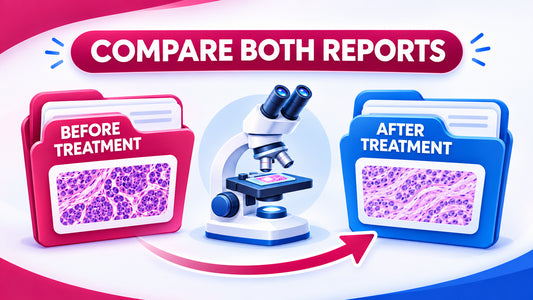
What do the two pathology reports actually say?
Keep the pretreatment biopsy report and the postoperative report together. Record the tissue sampled, the date, the HER2 immunohistochemistry score and any in situ hybridisation result, including FISH.
Under ASCO/CAP testing guidance, IHC 2+ requires further assessment; it is not a final positive result on its own. A negative classification refers to the testing interpretation, not necessarily the complete absence of HER2 protein. ASCO/CAP HER2 testing algorithm
Ask whether the newer result was measured in residual invasive cancer in the breast or a lymph node. Also ask whether the laboratory has compared the reports and whether pathology review would clarify the difference.
HER2 findings can change after preoperative therapy. That does not establish that the original result was wrong, nor does it prove that the remaining cancer will not respond to further treatment. Interpreting post-treatment HER2 changes
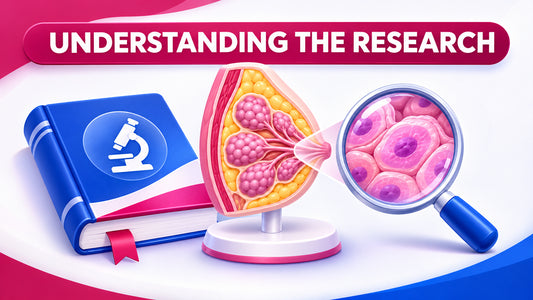
What does Professor Su's research add—and not answer?
Professor Fengxi Su coauthored a 2024 retrospective analysis of 871 patients with HER2-positive breast cancer who received neoadjuvant treatment between 2011 and 2022. Study of ER and PR patterns: PMID 38615482
The study compared hormone receptor patterns within HER2-positive disease. Pathological complete response rates differed among the groups, while disease-free and overall survival were not significantly different across those groups in the overall population.
This helps illustrate why a HER2-positive diagnosis is not the whole description of a cancer. ER, PR and response to treatment provide additional context.
However, that study did not establish a rule for stopping HER2-directed therapy when residual tissue retests negative. It was not a randomized comparison of postoperative treatment choices for that subgroup.
Bring ER and PR results as well as HER2 results to the consultation. Ask which evidence actually addresses the treatment decision you face, rather than assuming all research involving HER2-positive cancer answers the same question.
What did the KATHERINE subgroup show?
Among 845 KATHERINE participants with paired samples assessed, 70 had HER2-negative residual disease despite a HER2-positive pretreatment biopsy. The original analysis included 42 assigned to trastuzumab and 28 to T-DM1. Original subgroup report, 2022
The 2025 follow-up reported estimated seven-year invasive disease-free survival of 60.3% with trastuzumab and 95.2% with T-DM1 in this subgroup, after a median eight years of follow-up. Longer-term subgroup results
These findings support not withholding T-DM1 solely because residual disease retests HER2-negative. They do not give an individual patient a guaranteed outcome.
The subgroup was small and unevenly divided between treatments. It was a subgroup within a randomized trial, not a separate trial designed specifically for HER2-negative residual disease. Interpret the percentages with that limitation.

Does newer treatment change the discussion in 2026?
Yes. In May 2026, the US FDA approved trastuzumab deruxtecan, or T-DXd, for adjuvant treatment of adults with HER2-positive breast cancer and residual invasive disease after specified trastuzumab- and taxane-based neoadjuvant treatment. FDA approval and study summary
T-DXd and T-DM1 are different medicines. The FDA's announcement describes DESTINY-Breast05, which compared them, and warns about interstitial lung disease and pneumonitis with T-DXd.
The KATHERINE subgroup evidence discussed above concerns T-DM1. Do not assume that its exact results apply to another medicine or automatically establish eligibility under a newer drug label.
Ask your oncologist which treatment fits your original HER2 findings, residual disease, recurrence risk, previous therapy and health conditions. Discuss monitoring and side effects alongside expected benefit.
Confirm the applicable approval and availability where you will receive care; a US approval does not establish access in another country. Request a written plan that names the medicine, explains the reasoning and identifies who will review any unresolved pathology questions.
Sources and illustration notes
Prepared by the medChina Editorial Team. Sources checked on 19 November 2026: ASCO/CAP testing guidance, KATHERINE subgroup publications, the cited Professor Su coauthored study and the May 2026 FDA announcement.
This guide explains a discussion about postoperative treatment. It does not select a medicine or replace review by the treating oncology and pathology teams.
All images are AI-generated educational illustrations. Professor Su's illustrated consultation is imagined, not an actual clinical encounter or evidence that he reviewed this article.