
My Fibroadenoma Is Growing: Do I Need Surgery?
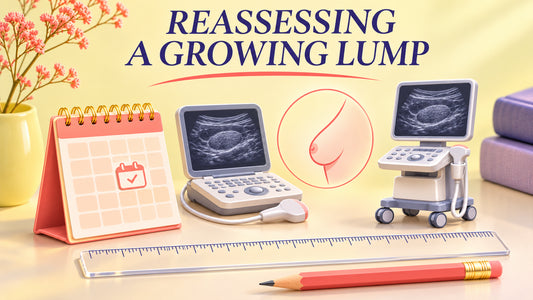
PATIENT GUIDE
Growth deserves a new assessment
A fibroadenoma that is getting bigger should be reassessed, even if an earlier biopsy was benign. Growth does not itself diagnose cancer, and it does not mean every fibroadenoma needs surgery. The decision depends on how confidently the lump is identified, how much it has changed, its symptoms and your preferences.
Fibroadenomas are benign growths containing glandular and supporting tissue. Some remain stable or shrink; others enlarge. A change in a previously assessed lump is a reason to contact your breast team, rather than assume the old explanation still settles every question. American Cancer Society: fibroadenomas
The 2025 ASBrS/SBI guideline supports selective removal of a biopsy-confirmed fibroadenoma without atypia when the findings agree: symptoms, substantial growth, size and patient preference can justify excision. That advice is for an established diagnosis, not an unexplained growing lump. 2025 ASBrS/SBI fibroepithelial lesion guideline
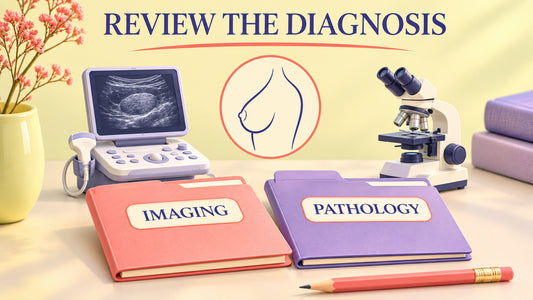
Is it definitely a fibroadenoma?
Ask to see the exact biopsy wording. A definite fibroadenoma is not the same as a broad description such as fibroepithelial lesion. Some lesions in that broader group need removal to establish what they are. When phyllodes tumor is suspected, the 2025 guideline recommends surgical excision. 2025 ASBrS/SBI fibroepithelial lesion guideline
Your team should compare the examination, earlier and current images, and pathology. A benign sample needs to explain the particular mass being assessed. Ask whether the reports refer to the same lump, especially if you have several.
Imaging measures the lump and describes its features; biopsy examines sampled tissue. Fast growth, an unclear result or concerning imaging can lead to discussion of removing the entire mass. Mayo Clinic: fibroadenoma assessment and treatment
Bring the old images as well as the written report. Ask the team to show you the measured change and explain whether it is substantial enough to change the plan.

How Professor Su’s research fits the decision
Fengxi Su coauthored a study following 1,578 patients after ultrasound-guided vacuum-assisted excision of benign breast disease. It examined recurrence and associated factors over a median follow-up of 34 months. Li et al., coauthored by Fengxi Su: benign breast lesion excision (2013)
This is background in minimally invasive management of benign breast lesions. It does not show that every growing fibroadenoma is suitable for a vacuum procedure, and it does not resolve a suspected phyllodes tumor.
For a surgical opinion, ask what must be achieved: a more certain diagnosis, relief of symptoms, or management of size and appearance. The answer helps explain why one procedure is being recommended.
An individual plan must come from the treating team after reviewing your records. This article is prepared by the medChina Editorial Team, not authored or medically reviewed by Professor Su.
Compare observation, excision and selected alternatives
If assessment remains reassuring, observation may be appropriate. For core-biopsy-confirmed, concordant fibroadenomas, the 2025 guideline allows return to age-appropriate screening without dedicated imaging follow-up. A changing or uncertain lump needs its own plan; do not use this statement to cancel an appointment. 2025 ASBrS/SBI fibroepithelial lesion guideline
Surgical excision removes the lump. Discuss the likely scar and possible change in breast shape, as well as anaesthesia and recovery. Mayo Clinic notes that surgery can alter appearance and that other fibroadenomas can develop later. Removal does not prevent every future lump. Mayo Clinic: fibroadenoma assessment and treatment
Selected benign lesions may be considered for vacuum-assisted excision, which takes tissue through a small skin opening. It carries risks including bruising, bleeding, pain and infection; the final tissue result may change what is needed next. Ask whether it would adequately answer the diagnostic question in your case. NHS: vacuum-assisted excision and risks
If avoiding an operation matters to you, say so. If uncertainty or symptoms are difficult to live with, say that too. Ask the clinician to compare the options for this particular lesion rather than choosing from a procedure name alone.

Make the next appointment useful
Prepare a short timeline: when the lump was first found, dates of scans and biopsies, and when you noticed a change. Bring reports, available images, a medication list and relevant family history. Mayo Clinic: fibroadenoma assessment and treatment
Write down three questions: What explains the growth? How certain is the diagnosis? What would change if I waited or chose removal?
If a procedure is proposed, ask what result you will receive, who will explain it, and when. Also ask about time away from work, lifting or exercise, and whom to contact for a wound problem.
Keep planned assessment while seeking another opinion. Contact the breast team about further changes rather than waiting simply because the earlier label was benign.
Records, support and sources
For an international consultation enquiry, gather the biopsy report, imaging reports and original image files if available. Ask whether pathology slides need review and how they should be transferred. Do not send sensitive records through an unconfirmed channel.
medChina can coordinate initial contact for assessment in China. The clinical team decides whether consultation or treatment is appropriate. The initial contact form does not provide a medical-record upload service; the team will explain submission arrangements separately.
General patient education. Evidence checked 18 November 2026. No individual diagnosis or treatment outcome is promised. Illustrative scenes, not records of actual patient care.
2025 ASBrS/SBI fibroepithelial lesion guideline
American Cancer Society: fibroadenomas
Mayo Clinic: fibroadenoma assessment and treatment
Li et al., coauthored by Fengxi Su: benign breast lesion excision (2013)