
ER Low Positive Breast Cancer: What Does 1%–10% Mean for Treatment?
PATIENT GUIDE
What does ER low positive mean?
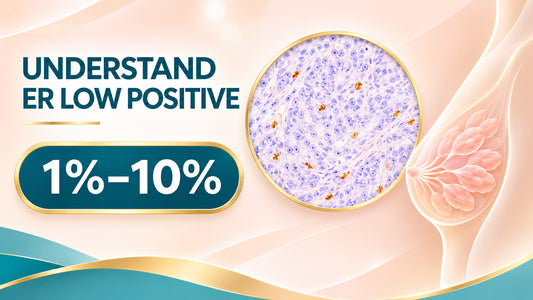
For invasive breast cancer, ER staining in 1%–10% of tumour-cell nuclei is reported as ER Low Positive under ASCO/CAP guidance. This is still a positive result, but the report should explain the more limited evidence about endocrine treatment benefit. CAP: ER testing guidance
The percentage describes staining in the tissue tested. It is not the percentage of your body affected by cancer or your percentage chance of survival.
Low-positive cancers are not all biologically alike. Some have gene-expression patterns closer to ER-negative cancers, so 'positive' should not be interpreted as identical to a strongly ER-positive result.
Keep the exact ER percentage, PR result and HER2 result together. Ask the oncologist to explain how the full pathology affects the treatment discussion rather than using one label alone.

Should the pathology result be reviewed?
CAP recommends laboratory procedures to check the validity of low-positive and negative results. The staining should be considered alongside the tumour's appearance and quality controls; unusual or discordant findings may need additional work. Checking low-positive results
The current CAP reporting template also calls for reporting control status with low-positive or negative ER results. A low result is not automatically an error, and a review does not automatically require a new biopsy. CAP breast biomarker reporting template
Ask whether the result was confirmed through the laboratory's review process and whether any further assessment of existing tissue is appropriate.
If two reports disagree, bring both complete documents. Ask which specimen each result came from, whether treatment occurred between samples, and which result the team is using for the current decision.

Why do study definitions need careful checking?
Professor Fengxi Su coauthored a 2024 retrospective study of 871 patients with HER2-positive breast cancer receiving treatment before surgery. It examined ER and PR expression patterns, treatment response and survival. HER2-positive cohort: PMID 38615482
Its analysis defined low ER as 1%–9% and high ER as at least 10%. That research grouping is not identical to the pathology-report category of 1%–10%; a result of exactly 10% sits differently in the two definitions.
The study found differences in pathological complete response across hormone-receptor groups, while overall survival comparisons between the main subtypes were not statistically significant.
It was not a trial of giving versus omitting endocrine therapy, and all included cancers were HER2-positive. It cannot by itself tell someone with ER-low, HER2-negative cancer to skip endocrine treatment or chemotherapy.
When a paper is quoted, ask whether its receptor definition, HER2 status, treatment and outcome match your situation. A familiar label is not enough.
Is there evidence for discussing endocrine therapy?
Yes. A 2025 National Cancer Database analysis included 7,018 patients with high-risk stage I–III ER-low disease who received chemotherapy. Not starting endocrine therapy was associated with worse overall survival after adjustment. Study of endocrine-therapy omission
Median follow-up was three years. This was observational evidence, so it cannot remove every difference between people who did and did not start treatment or give your exact individual benefit.
Some subgroup comparisons did not reach statistical significance. That does not prove that endocrine therapy has no benefit in those subgroups or establish a safe self-directed omission rule.
ASCO's 2026 living guideline for hormone receptor-positive, HER2-negative early breast cancer recommends endocrine therapy for low receptor expression while acknowledging uncertainty about the size of benefit. ASCO living guideline, version 2026.1.0
Discuss the expected benefit, possible side effects and your preferences with the treating oncologist. Do not stop prescribed therapy solely because the ER percentage is small.

How do I use this information at my appointment?
Ask the team to state the confirmed ER percentage and explain the meaning of the low-positive comment. Request clarification if the report simply says 'positive' without the detail you need.
Ask separate questions about endocrine therapy, chemotherapy and any HER2-directed treatment. Eligibility for one treatment does not, by itself, answer whether another is needed.
If the recommendation includes endocrine therapy, ask what benefit is expected in your circumstances, what remains uncertain and how side effects will be managed.
If the team recommends omitting a treatment, ask which evidence and personal factors support that decision. A written explanation can help you understand how the recommendation was reached.
For a second opinion, provide the full pathology and treatment history, not just an ER screenshot. Ask whether slides or tissue blocks are needed and how the review will be coordinated.
Leave with a clear next step and a contact for unresolved questions. Keep your existing treatment appointments while clarification is arranged.
Sources and illustration notes
Prepared by the medChina Editorial Team. Sources checked on 19 November 2026: ASCO/CAP guidance, CAP's biomarker template, the 2026 ASCO living guideline and the two cited studies.
This guide concerns invasive breast cancer with low ER expression. It does not select an individual's systemic treatment.
All images are AI-generated educational illustrations. Professor Su's illustrated discussion is imagined, not an actual consultation or evidence that he reviewed this article.