
When Can Drains Be Removed After Mastectomy?

PATIENT GUIDE
Is there a fixed day when my drain should come out?
No. After mastectomy, your surgical team decides when each drain can be removed using the operation you had, the drainage record and your recovery. A date on someone else's calendar is not a deadline for you. Do not remove a drain yourself.
For example, Memorial Sloan Kettering asks patients to call when output is 30 mL or less over 24 hours, while noting that some procedures require keeping the drain longer. This is a hospital-specific instruction, not an automatic removal rule for everyone. MSK: Jackson-Pratt drain care.
This guide is for people already sent home with a surgical drain. It does not determine whether you should have a drain or replace your discharge instructions. Before leaving hospital, ask: “What output threshold and number of days apply to each of my drains, and who schedules removal?”
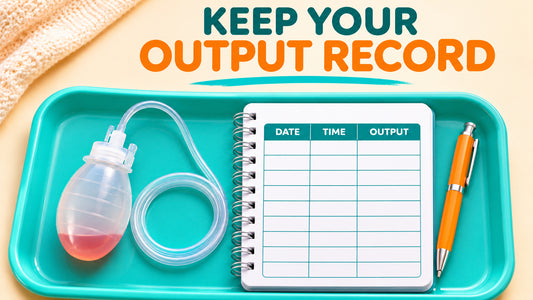
What should I record while I am waiting?
Record each drain separately; do not combine their amounts. Bring the log to follow-up. A sudden fall in output is not always a sign that removal is due: a blockage or suction problem may need attention. MSK drain guide.
A suction drain carries fluid from the surgical area into a collection bulb. Alberta Health advises recording the amount, date and time, and supporting the bulb so the tubing does not pull on the skin. Learn the emptying and care method from your nurse, including what to do if you need help. Alberta Health: breast surgery drain care.
Useful entries include the drain identifier, measured amount, time emptied and any new concern. Ask your nurse to check that you understand how to calculate a 24-hour total. A photograph of a full bulb cannot replace a measured record.

What does Professor Su's research contribute?
Professor Fengxi Su coauthored a randomized study comparing locally applied Sapylin and Avitene for fluid accumulation after axillary lymph-node dissection. Published in the Journal of Surgical Research in April 2017, it addresses postoperative fluid management in a specific surgical setting. Zhao and colleagues, PMID 28457344.
That study does not establish a universal home-care protocol or a removal day for every mastectomy, reconstruction or drain. It is not a reason to request or use either product yourself. Its relevance is the team's research experience with axillary surgery and postoperative fluid problems.
For an individual review, ask how your breast operation, any axillary procedure and any reconstruction affect the follow-up plan. Bring the operative summary, discharge instructions, recent drain log and your questions. Do not delay a scheduled local assessment while arranging another opinion.
What happens at removal, and will it hurt?
A clinician usually removes the drain during follow-up. Alberta Health describes a brief pulling sensation; experiences vary, so tell the team if you are worried or have had painful procedures before. Ask what comfort measures are appropriate for you. Do not cut the holding stitch or pull the tube yourself. Alberta Health: drain removal.
Before you leave, ask for written instructions about the small drain-site dressing, showering and whom to contact if fluid continues to leak. If removal is deferred, ask for the reason and the next review point rather than assuming that something has gone wrong.
Keeping the drain temporarily and arranging another review may be the plan. New swelling after removal needs assessment; an existing surgical drain and needle drainage of a later fluid collection are different situations. Our seroma guide explains that separate question.

Which changes mean I should contact the team?
Contact your surgical team promptly for new bright-red drainage, fever, increasing redness, warmth, swelling, tenderness or pus. Also report an abrupt output change, loss of suction or a drain that comes out. Follow your own discharge team's temperature threshold and urgent-contact instructions. MSK warning signs.
If a tube comes out, cover the site with clean gauze and contact the team; do not push it back in. Alberta Health guidance. If bleeding is heavy or you feel acutely unwell, seek urgent local medical care rather than waiting for an online enquiry.
For an enquiry about breast cancer treatment in China, medChina can help coordinate contact about Professor Su's services. This is not an emergency drain-care service. Your surgical team remains responsible for the immediate postoperative plan; the coordination team will explain how records should be submitted separately from the initial contact form.
Prepare three questions and keep your follow-up
Write down: “Which drain can come out, and why?” “What should I do if it must stay longer?” “What care changes after removal?” Add your actual travel, work or caregiver constraints so the team can plan with you.
If you have had reconstruction, clarify whether the breast or plastic-surgery team is arranging drain removal. Keep the agreed follow-up rather than cancelling because the output has not reached a number you saw online. MSK mastectomy follow-up checklist.
References: MSK — Caring for Your Jackson-Pratt Drain, updated November 6, 2026; Alberta Health — Breast Cancer Surgery: Drain Care; MSK — Mastectomy checklist; Zhao et al., including Fengxi Su — prospective randomized study, 2017, DOI 10.1016/j.jss.2016.10.032.
Prepared by the medChina Editorial Team. Sources checked November 18, 2026. Educational information does not replace individual clinical advice.
Illustrative scenes, not records of actual patient care.