
Do I Need a Breast MRI Before Surgery?

PATIENT GUIDE
Does everyone need an MRI before breast surgery?
No. A breast MRI can help answer a specific question about where the cancer is and how far it extends, but it is not automatically needed by every person preparing for surgery.
The useful question is: “What could this scan change in my treatment?” Ontario Health recommends an individual decision when extra information about cancer extent could affect care, taking your preferences and the possible downsides into account. Read the Ontario Health guideline.
MRI is an additional test, not a replacement for your biopsy or the rest of your assessment. It uses magnetic fields rather than X-rays; cancer assessment usually involves an injection of contrast. RadiologyInfo explains breast MRI.
If your surgeon has not ordered one, ask for the reason. If one is recommended, ask what uncertainty it will resolve. Either conversation can help you feel more in control without delaying your existing appointments.
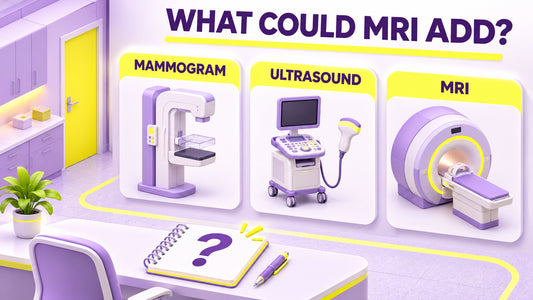
When is a breast MRI more likely to help?
It is most useful when a clearer picture could change a real treatment decision.
Examples include invasive lobular cancer, disagreement about the extent of disease, or suspected cancer in more than one area. Dense tissue can also make assessment harder. The Ontario guideline gives a stronger recommendation for invasive lobular cancer when knowing its extent could influence treatment. Ontario Health recommendations.
Other situations include planning nipple-sparing or oncoplastic surgery, concern about the chest wall, or hereditary risk without a recent MRI. Some recommendations rely on expert judgment rather than direct comparison trials. A factor on this list does not decide the question by itself. See the evidence and its limits.
MRI before and after chemotherapy given before surgery serves a different purpose: assessing treatment response and planning the operation. The 2026 European consensus supports that use. Do not use advice about routine scans before upfront surgery to cancel a response-assessment scan. European multidisciplinary consensus.

If MRI finds another spot, do I need a mastectomy?
An additional suspicious finding is a reason to investigate, not an automatic diagnosis of another cancer.
MRI can show areas that turn out to be benign. The American Society of Breast Surgeons emphasizes tissue confirmation when an uncertain finding would change breast conservation to mastectomy. Ask what has actually been confirmed before agreeing to a larger operation. ASBrS MRI resource guide.
The 2026 European consensus describes a targeted “second-look” ultrasound to look again at the MRI finding. If there is no ultrasound match and the finding needs sampling, an MRI-guided biopsy may be required. The service should be able to arrange this, including through another center. Read the work-up recommendations.
Useful questions are: Which spot is already proven cancer? Which is still uncertain? Will a biopsy result change the operation? When will we have that result, and who will explain it?
If more than one cancer focus is confirmed, ask the team to explain the available surgical choices for your specific pattern. Our guide to multiple areas of breast cancer.
What do recent studies—and the downsides—mean for me?
Finding more detail does not necessarily mean that every patient has a better outcome. A study published September 23, 2026 reviewed 261 patients having surgery first. MRI sometimes changed the operation, but the groups had no significant difference in early recurrence. It was retrospective, the groups differed, and follow-up was limited; it cannot prove MRI has no benefit. Read the original 2026 study.
A randomized trial reported at SABCS in December 2025 studied 319 people with stage I–II hormone-receptor-negative cancer who were eligible for lumpectomy. It found no significant five-year recurrence benefit from adding MRI. People with inherited BRCA1/2 mutations, bilateral cancer or previous breast cancer were excluded. This conference report should not be generalized to everyone. AACR trial report.
Possible downsides include false alarms, extra biopsies, cost and a longer wait for a final plan. Ask how the team will coordinate any additional tests with surgery. ASBrS resource guide.
Tell the imaging team about implanted devices or metal, kidney disease, previous contrast reactions, possible pregnancy and claustrophobia. Many implants can be scanned under appropriate conditions, but the exact device must be checked. If MRI is unsuitable, ask which alternative best answers the clinical question. MRI preparation and safety · European imaging guidance.

What should I bring to a specialist discussion?
Bring your biopsy report, imaging reports and the actual images if available, plus your current treatment plan and previous breast-operation details.
Write down three questions: What is uncertain about my cancer’s extent? What result would change my operation? If MRI finds something else, how will it be checked before the plan changes?
Professor Fengxi Su’s clinical focus includes breast conservation, oncoplastic or reconstructive planning, lymph-node management and margin assessment. Imaging is one part of bringing those decisions together. Explore Professor Su’s clinical focus.
Su coauthored the Chinese Society of Breast Surgery’s 2021 breast-conserving surgery guideline. This is a verified professional contribution, not evidence that everyone needs MRI or that he has reviewed your case. View the original guideline record and authors.
To explore a consultation, contact medChina with your main question. The team can explain availability and how to share reports through an appropriate channel. Keep your existing care appointments while arrangements are discussed. You can ask for a clear reason for each test and a clear next step.
Sources and editorial information
Prepared by the medChina Editorial Team. Sources checked November 4, 2026. This guide is educational information, not an individual assessment or medical review by Professor Su.
References: Ontario Health preoperative MRI guideline (2023); EUSOBI/ESSO/ESP/ESTRO consensus (June 2026); Çelik et al., preoperative MRI study (September 2026); AACR: Alliance A011104 trial report (December 2025); ASBrS MRI resource guide; RadiologyInfo: breast MRI (reviewed June 2026); Chen et al., CSBrS guideline, with Feng-Xi Su (2021).
Illustrative scenes, not records of actual patient care.