
Blue Urine After Sentinel Node Biopsy: Is It Normal?

PATIENT GUIDE
Can blue or green urine be expected after the operation?
Yes—if blue dye was used for sentinel lymph node mapping, it can temporarily colour urine blue or green. This can be surprising after breast surgery, especially if you do not remember the explanation given before your anaesthetic.
Hospital leaflets describe slightly different durations: Memorial Sloan Kettering describes one to two days, while Hull University Teaching Hospitals describes 24–72 hours. These are general expectations, not a rule that makes every colour change harmless. Hull NHS: sentinel lymph node surgery
Check your discharge information to confirm whether dye was used and what your own team expects. If that is unclear, or the change lasts beyond their expected course, contact the surgical team rather than assuming the cause.
The colour alone does not show whether cancer was found. The dye helps locate lymph nodes; the laboratory examination of the removed tissue provides the cancer result. NCI: what sentinel node biopsy measures
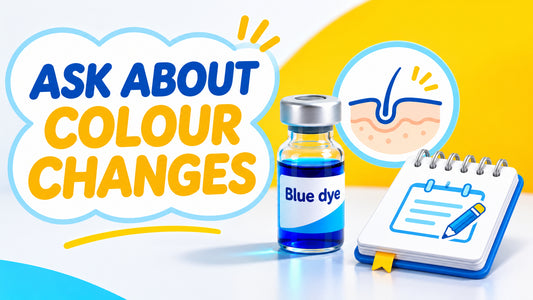
Why can a skin stain last longer than the urine colour?
A local blue-green stain around the injection or incision area can fade much more slowly. MSK notes that a faint mark may remain for up to 12 months in some people. That is different from dye passing through urine over the first few days. MSK: expected colour changes
Keep following the wound-care instructions for your particular operation. A colour change does not mean surgical glue, strips or dressings should be removed early to clean underneath them.
A known local dye stain should not become an explanation for every new wound change. Increasing redness, swelling, warmth, drainage or fever warrants contact with your healthcare team. MSK: when to call your provider
If you also had mastectomy or reconstruction, use that operation’s instructions too. A new dark nipple or changing skin flap requires its own assessment. Read about a dark nipple after nipple-sparing surgery

Which symptoms need emergency help?
Sudden trouble breathing, swelling of the tongue or throat, fainting, or marked confusion can signal a severe allergic reaction. Call your local emergency number immediately; do not wait for an online reply. NHS: signs of anaphylaxis
Blue or grey lips, particularly with breathing difficulty or collapse, must not be dismissed as ordinary postoperative dye staining. This is different from a known local stain on the breast.
If you have an adrenaline auto-injector prescribed for you and suspect anaphylaxis, use it as instructed while emergency help is called. Follow emergency-service advice.
Emergency symptoms take priority over checking which dye was used. You can give clinicians the operation details when help is on the way.
What does Professor Su’s early sentinel-node research tell us?
A 2002 paper with Fengxi Su as first author studied factors associated with identifying sentinel lymph nodes using blue dye in 108 patients with operable stage I or II breast cancer. Su and colleagues: PubMed PMID 11955410
The investigators examined clinical and procedural factors related to finding the node, including age, tumour location and prior biopsy. This helps explain the historical role of dye as a surgical mapping tool.
It was not a study designed to establish how long urine should remain blue, diagnose an individual colour change, or prove the absence of allergic reactions. Its historical identification results should not be treated as the performance of every modern mapping technique.
Today’s postoperative advice should come from the procedure actually performed and the treating team’s discharge guidance. Citing this research does not mean Professor Su reviewed this article or your symptoms.

What information should I have ready when I call?
Keep the operation date, discharge sheet and the surgical team’s daytime and out-of-hours numbers together. Ask whether blue dye, a radioactive tracer, or another mapping method was used; these are not interchangeable labels. NCI: mapping methods
Describe where the colour change is, when it started, whether it is fading, and any other symptoms. A simple account is more useful than trying to name a complication yourself.
Ask: “Is this the expected course for the dye I received, and what should make me call again?” Confirm who to contact overnight.
Use your treating hospital for postoperative concerns. This website’s general enquiry form is not an emergency service and cannot assess an evolving wound or allergic reaction.
Sources, authorship and illustration notes
Prepared by the medChina Editorial Team. Sources checked on 19 November 2026: Hull NHS sentinel-node guidance, MSK postoperative advice, the NCI sentinel-node fact sheet, NHS anaphylaxis guidance and the cited 2002 research paper.
This is general patient education, not a diagnosis or an individual postoperative plan. Your surgical team’s instructions depend on the operation and your health.
Images are AI-generated educational illustrations. The blue-ink scene is a visual metaphor, not a medical product or dosing guide. The illustrated Professor Su scene is not a real consultation, photograph or endorsement.