
Can an AI MRI Result Replace a Lymph Node Biopsy?

PATIENT GUIDE
An AI scan says my lymph nodes look clear. Can I skip biopsy?
An imaging prediction alone is not enough to decide whether to omit lymph-node sampling. Your team must consider the examination, imaging, cancer features, treatment plan and the evidence supporting the proposed approach.
Some carefully selected patients can avoid sentinel lymph-node biopsy under current clinical guidance. That decision is based on defined clinical criteria and whether the node result would change treatment—not simply on a reassuring AI score. ASCO sentinel lymph-node guideline update
Before cancelling a planned test, ask what it is intended to answer and why your team recommends it. A needle biopsy of an abnormal node and a sentinel-node operation serve different purposes.
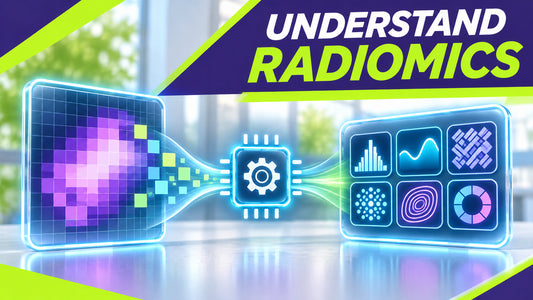
What is MRI radiomics actually doing?
Radiomics uses computer analysis to extract measurable patterns from images. Researchers can combine those patterns with clinical information to build a model that predicts whether lymph nodes are involved. MRI radiomics research
Prediction is different from seeing cancer cells under a microscope. A model can miss disease or label a benign finding as suspicious, and its performance may change with the patients, scanners and methods used.
The term “AI” does not identify one universal test. Ask for the exact system, what it was designed to predict and how its result is being used in your case.
The images in this guide are conceptual. The screen drawings, slide case and research charts are not your scan, a validated software interface or evidence that a biopsy can be omitted.
Why might a clinician still recommend node sampling?
In the NICE assessment pathway, abnormal axillary nodes identified on ultrasound are sampled with an ultrasound-guided needle procedure. The aim is to obtain information from the suspicious finding rather than relying only on its appearance. NICE: pretreatment axillary assessment
Sentinel-node biopsy is a surgical assessment of the first draining lymph nodes. Whether it is needed depends on the clinical setting; the same answer does not apply to every patient or every stage of treatment.
Ask: “Would this result change surgery, radiation or drug treatment? If the sample is negative, does it answer the question completely, or is another assessment still needed?”
If the reports seem to disagree, ask the radiologist, pathologist and treating team to review them together. Do not assume that a computer-generated result should automatically overrule tissue findings or the clinical plan.
What did Professor Su’s MRI study demonstrate?
A 2021 multicentre study co-authored by Fengxi Su analysed 1,088 patients across development and validation cohorts. It investigated MRI features of the tumour and axillary nodes, with a combined model also incorporating clinical and pathological information. Yu and colleagues, EBioMedicine
The models showed promising ability to distinguish node-positive from node-negative cases in the studied cohorts. The authors also explored relationships between imaging features and the tumour microenvironment.
This was a prediction study, not a randomized trial showing that using its score to omit node surgery preserves long-term outcomes. Its results do not establish routine availability at a particular hospital or approval for replacing biopsy.
An AUC value describes discrimination across a study population; it is not your personal probability that skipping a procedure is safe. The illustrated research meeting is imagined, and its graphs are not the published data.

How can I discuss avoiding unnecessary surgery?
Ask whether you meet an established omission pathway. ASCO’s 2025 guidance includes selected patients with small, favourable tumours and reassuring axillary assessment, with additional requirements about age, menopausal status, surgery and treatment. A clinician must check the complete criteria. Who may be considered for SLNB omission
A clinician-reviewed imaging result can contribute to that assessment. It should not be confused with adopting an unvalidated AI prediction as a stand-alone rule for everyone.
Ask: “Was this model independently validated in patients like me? Is it being used in a research study? What is the risk of a missed node finding, and what would we do if the result conflicts with other tests?”
Bring your biopsy report, receptor results, imaging reports and the proposed operation plan. Tell the team which concern matters most—arm symptoms, recovery, uncertainty or avoiding an unnecessary procedure.
The goal is a justified plan with clear trade-offs. If seeking another opinion, ask for review of the whole pathway rather than asking only whether a particular scan looks normal.
Sources, scope and editorial notes
Prepared by medChina Editorial Team. Sources checked 18 November 2026. General patient education; this article was not medically reviewed by Professor Su.
Current selection-based sentinel-node omission guidance: ASCO 2025 guideline
Axillary assessment and sampling recommendations: NICE NG101
Research context: multicentre MRI prediction study, PMID 34233259: Original study abstract
Illustrative scenes, not records of actual patient care. This article does not certify a particular AI product or recommend cancelling a biopsy.