
What Happens During Sentinel Lymph Node Biopsy? | Professor Fengxi Su
01 · Understand the question
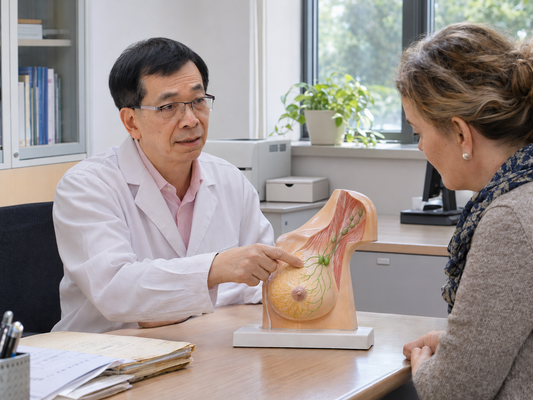
What happens during sentinel node biopsy?
A marker (tracer) helps the surgeon find the first nodes that drain the breast. The surgeon removes the identified nodes, and a pathologist checks them for cancer cells. There may be more than one sentinel node.
- “First” describes drainage, not a cancer diagnosis.
- The sample needs examination to determine whether cancer is present.

How are the nodes located?
A tracer helps the surgical team follow lymph drainage and find the nodes to sample. Different tracers or combinations may be used. Professor Su’s early research studied identification using blue dye.
- Ask which mapping method is planned.
- Tracer colour or signal does not itself mean a node contains cancer.
What happens to the removed nodes?
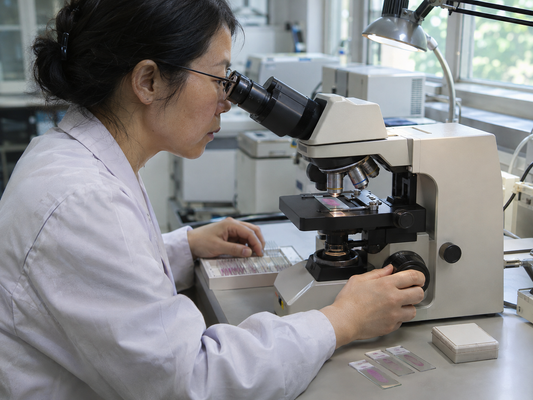
The sampled tissue is examined for cancer cells. The operation provides the tissue; the laboratory assessment provides the result. These are related but separate parts of the process.
- Ask when results are expected.
- Keep a copy of the final pathology report.

02 · Weigh the details
Will I know the answer during the operation?
Not always. Some situations involve assessment during surgery; others rely on the final laboratory report. An earlier study coauthored by Professor Su compared a molecular test used during surgery with tissue examination. The methods did not agree in every sample.
- Ask whether an intraoperative result would change your operation.
- An early result does not replace the final pathology report.
Assessment during surgery is not needed in every case.

How should I read the older studies?
Professor Su’s 2002 study helps explain why finding a sentinel node is a technical process. Those results describe the patients and methods used in 2002; they do not predict your result today.
- Methods and clinical situations differ.
- Ask your team about its approach and relevant uncertainties.
What if a sentinel node cannot be found?
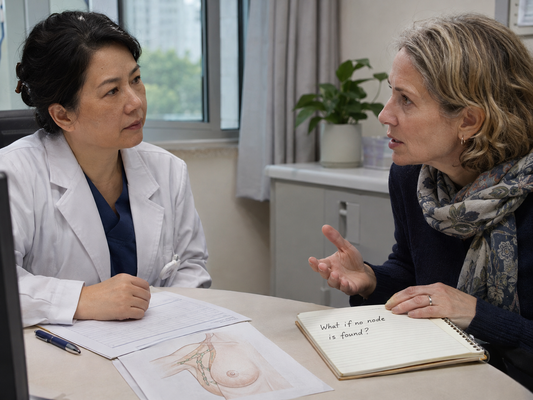
Not finding a node is different from finding a node that tests negative. Ask before surgery how the team would respond if mapping is unsuccessful, using your disease and treatment situation to guide the next step.
- A missing sample is not a negative pathology result.
- The next step needs an individual clinical decision.

Does a positive node always mean more surgery?
Not always. When cancer is found in a sentinel node, the number of affected nodes, the amount of cancer in them, your breast operation, any treatment before surgery and planned radiotherapy all matter. The result needs a treatment discussion.
- Ask what the report says about the affected nodes.
- Review the result with the complete treatment plan.
03 · Prepare your next step
What should I know before going home after surgery?
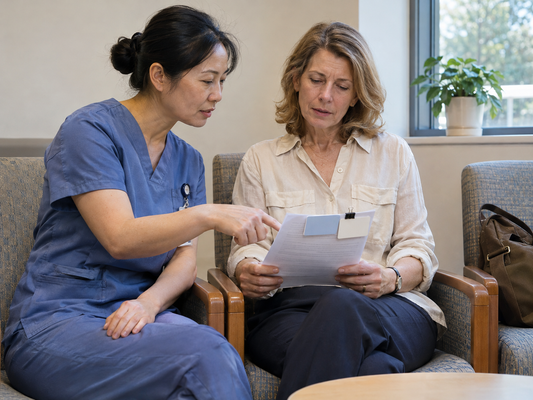
Confirm who will explain the final pathology and whom to contact about postoperative concerns. Ask what arm or underarm changes should be reported and whether you need individual guidance on movement and recovery.
- Results: know when they will be reviewed.
- Recovery: follow the instructions for your own operation.
Evidence and Further Reading
This educational guide draws on publications coauthored by Professor Fengxi Su. Additional current guidance is identified separately. The explanations support discussion with your care team and do not determine individual treatment.
- [Clinical and histological factors associated with sentinel node identification in breast cancer]. (2002). Coauthored by Professor Su.
- GeneSearch™ BLN Assay could replace frozen section and touch imprint cytology for intra-operative assessment of breast sentinel lymph nodes. (2013 online / 2014 issue). Coauthored by Professor Su.
- ASBrS Resource Guide: Technical Considerations for Axillary Surgery in Breast Cancer Patients (2026). Additional guidance; not authored by Professor Su.
- ASBrS Resource Guide: Axillary Management for Patients With In-Situ and Invasive Breast Cancer (2026). Additional guidance; not authored by Professor Su.
Related guides
Use the contact form to ask about consultation arrangements. Sending a message does not confirm an appointment. The form is not an emergency service.