
Breast Reshaping After Cancer Removal | Professor Fengxi Su
01 · Understand the question
Is breast shape only about the skin scar?
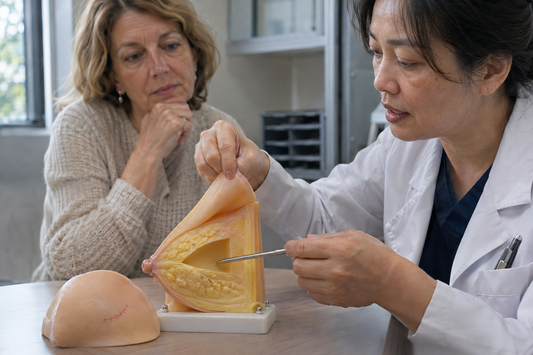
No. The internal tissue removed and the way remaining tissue is arranged both affect contour. The skin incision is another part of the plan. A small visible scar alone does not describe the whole result.
- Inside: consider the missing volume.
- Outside: consider the incision and visible contour.
Internal volume and the visible incision are different parts of the reshaping plan.

Why does the tumour location matter?
Removing tissue from different parts of the breast can affect contour differently. The technical commentary coauthored by Professor Su illustrates approaches selected around the position of the affected area.
- Ask where the expected defect will be.
- Ask why the suggested technique fits that location.
How does the amount of remaining tissue matter?
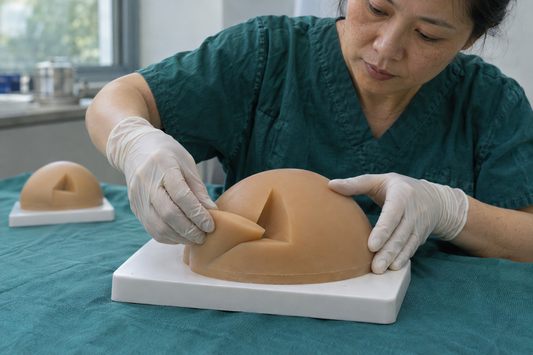
Reshaping uses the tissue and anatomy available after the cancer has been removed. There is no single rearrangement that suits every breast or every size of defect.
- The cancer operation determines the tissue that must be removed.
- The reshaping plan must work with what can safely remain.
Conceptual teaching model; the tissue movement depends on the individual operation.
02 · Weigh the details
What is a round-block approach?
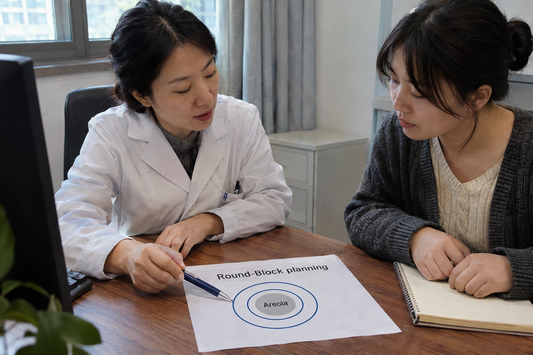
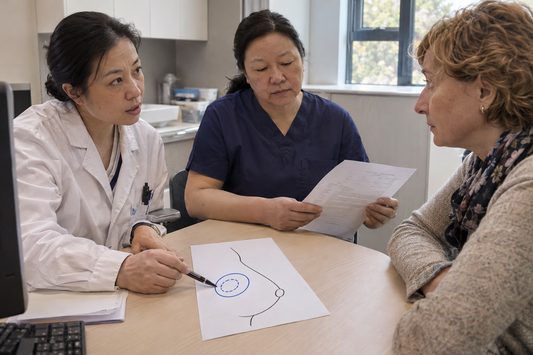
A round-block approach combines an incision around the areola with rearrangement of the remaining breast tissue. The commentary includes an example attributed to Professor Su and Jiannan Wu. It illustrates a technique; it cannot predict your result.
- The areola is the darker skin around the nipple.
- Ask whether this approach fits the disease location and your anatomy.
Conceptual peri-areolar planning marks; not a complete operative demonstration.
Does “scarless” mean no scars?
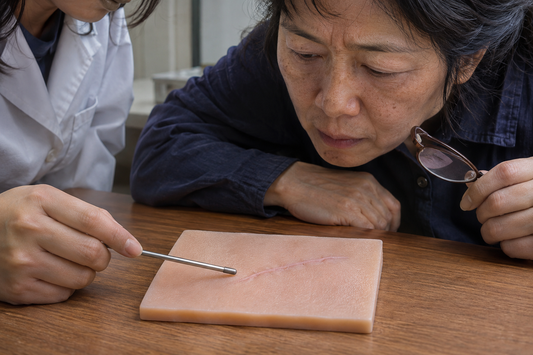
In the commentary, the aim is to reduce visible scarring. It does not mean that surgery leaves no scar or causes no tissue injury. Discuss where the incision would be and what appearance is realistic to expect.
- Ask about the expected incision location.
- Keep scar visibility separate from cancer safety.
Less visible scarring still leaves a scar; healing varies from person to person.
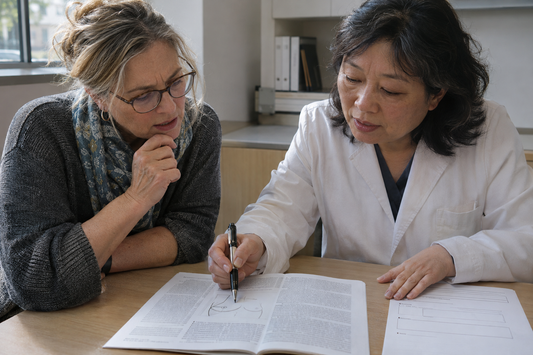
Can the paper predict my final appearance?
The commentary cannot calculate your personal chance of symmetry or satisfaction. It calls for stronger studies of cancer safety and cosmetic outcomes. Technique photographs do not replace those outcome studies.
- A demonstration shows a possible method.
- It does not establish a guaranteed result.
What happens if the cancer needs a wider operation?
The plan may need to change if the disease is more extensive or clear margins cannot be achieved. Ask how the team would balance cancer removal with reshaping, and what alternatives would then be considered.
- Ask about the plan if pathology changes the picture.
- Discuss possible further surgery before the first operation.

03 · Prepare your next step
How can I explain the result I hope for?
Tell the surgeon which concerns matter most: contour, visible scars, symmetry or avoiding additional procedures. Ask what the proposed operation can reasonably address and which aspects remain uncertain.
- Use your own priorities, not another person’s photograph.
- Ask for the reasoning behind the proposed design.
Evidence and related guides
This educational guide draws on publications coauthored by Professor Fengxi Su. Additional current guidance is identified separately. The explanations support discussion with your care team and do not determine individual treatment.
- In pursuit of a flawless aphrodite: paving the way to scarless oncoplastic breast surgery. (2019). Coauthored by Professor Su.
- Clinical practice guideline for breast-conserving surgery in patients with early-stage breast cancer: Chinese Society of Breast Surgery (CSBrS) practice guidelines 2021. (2021). Coauthored by Professor Su.
Related guides
Use the contact form to ask about consultation arrangements. Sending a message does not confirm an appointment. The form is not an emergency service.