Impacted Tooth Traction in China

Regular price $890.00
Service unit: Per tooth

Secure checkout

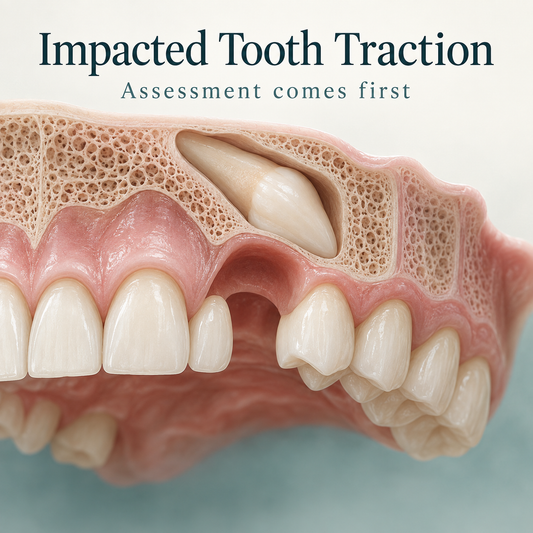
An unerupted tooth is shown beneath the gum in a teaching model. Educational illustration.
Impacted Tooth Traction in China
Regular price $890.00

Explore a Plan for an Impacted Tooth.

An unerupted tooth may sometimes be guided into the dental arch after surgical and orthodontic assessment. Its position, available space and neighbouring structures matter. This listing is priced per tooth; suitability and the full treatment scope require confirmation.

Ask About Tooth Traction

WHAT MATTERS TO YOU

Three Questions Before Choosing Traction.

Begin with the tooth’s position, its prospects for retention and the practical demands of continuing orthodontic care.

Can the tooth be retained?

An assessment considers the impacted tooth, surrounding tissues and adjacent teeth. A tooth that has not erupted is not automatically suitable for traction.

Is there space and a feasible path?

The orthodontist assesses available space and the relationship to neighbouring roots. The proposed movement and risks belong in an individual plan.

How will continuing care work?

Discuss the overall orthodontic treatment, regular supervised reviews and what may need to change if the tooth does not respond as expected.

HOW IT WORKS

Coordinate the Surgical and Orthodontic Plan.

Four conversations to organise before treatment or travel. People shown are illustrative, not actual staff or patient testimonials.

STEP 01

Describe the unerupted tooth

Tell us which tooth is affected, previous dental advice and any current braces. Ask how to share existing records securely.

STEP 02

Arrange the clinical assessment

The treating team decides which examination and imaging are needed to evaluate position, space and neighbouring structures.

STEP 03

Define the proposed components

Clarify any surgical exposure, bonded attachment, traction assembly and associated orthodontic care in writing.

STEP 04

Plan continuing reviews

Agree how appointments, clinical reassessment and care near home will be organised before committing to travel.

PRODUCT IDENTITY • SPECIFICATION • YOUR PLAN

One Tooth, Within a Wider Orthodontic Plan.

Connect the per-tooth item with the assessed clinical objective and wider orthodontic plan.

A per-tooth traction service

The source lists impacted-tooth traction per tooth. It does not identify a specific appliance brand or establish a complete orthodontic package.

A clinically selected objective

The aim is to guide a suitable impacted tooth toward the dental arch. Retention and successful movement cannot be guaranteed for every tooth.

Separate components and coverage

Exposure, bonding, traction apparatus, imaging and long-term reviews must each be checked against the quotation.

UNDERSTAND YOUR TREATMENT

Understand Tooth Position and the Traction Connection.

Educational diagrams show the concept without predicting your anatomy, appliance design or outcome.

TOOTH POSITION

The tooth beneath the surface

A simplified cutaway can explain a tooth that remains beneath gum or bone. Imaging and examination establish its actual position and the relationship to nearby roots.

PRESCRIBED CONNECTION

The clinician-planned connection

Some plans use a bonded attachment connected to an orthodontic appliance. The clinician selects the approach and monitors it; an illustration is not a device specification or self-adjustment guide.

UNDERSTAND YOUR QUOTATION

Six Details to Confirm in the Traction Quote.

Confirm each service below in your written quotation. This checklist does not mean that every stage is included in the listed item.

Clinical examination and imaging requirements are clarified. Educational illustration.
01

Assessment and imaging

Confirm the examination and imaging requirements and whether they are separately charged.

Surgical exposure is a component to confirm. Educational illustration.
02

Surgical exposure, if needed

Ask whether exposing the tooth is required, who performs it and whether the listed price includes it.

Bonding and attachment coverage are specified. Educational illustration.
03

Bonded attachment

Confirm the attachment, bonding procedure and coverage if it needs attention during care.

Local traction and base orthodontic care are separate scope questions. Educational illustration.
04

Traction appliance and base orthodontics

Separate the local traction assembly from the wider braces or other orthodontic treatment.

The orthodontist monitors the tooth during continuing care. Educational illustration.
05

Supervised reviews

Confirm the appointments, monitoring period and arrangements for problems or interrupted care.

Reassessment can lead to continued traction or an alternative plan. Educational illustration.
06

Reassessment and alternatives

Discuss how the team will reassess progress and explain alternatives if traction is unsuitable or unsuccessful.

Educational illustrations. Components, clinical suitability and the agreed service scope require an individual plan.

PLAN THE WHOLE JOURNEY

Before Traction, During Care and at Reassessment.

Plan your appointments and continuing care around the clinical assessment. Images are educational illustrations, not actual patient cases.

BEFORE

Before traction

Review the impacted tooth’s position, neighbouring structures and available space. Confirm the surgical and orthodontic responsibilities, risks and full costs.

DURING

During supervised care

Attend the agreed reviews and follow individual cleaning and appliance-care instructions. Contact the clinic about a loose attachment, discomfort or an appliance problem.

AFTER

At reassessment

The team evaluates the tooth’s response and the wider bite. Further alignment, retention or an alternative approach depends on the clinical findings.

BEFORE YOU DECIDE

Clarify the Total Plan and Continuing Appointments.

An itemised plan clarifies possible separate charges. Educational illustration.
01

Check every separately priced component

The per-tooth listing does not automatically include exposure, bonding, traction equipment, baseline orthodontic treatment, imaging or extended reviews. Request a complete itemised plan.

The schedule is individual and includes continuing reviews. Educational illustration.
02

Agree a realistic personal schedule

No fixed duration, visit count or speed of movement is supplied by the source. Coordinate continuing care with the treating team before planning travel.

Illustrative planning scenes. Your written quote and clinical plan define the scope and appointments.

YOUR WRITTEN PLAN

Details to Confirm Before Payment.

Keep the tooth identity, proposed components, full costs and review arrangements together.

Which impacted tooth is being considered?

Why is traction appropriate?

Is surgical exposure included?

Which attachments and appliances are proposed?

What reviews are covered?

What if the tooth does not respond?

PRACTICAL QUESTIONS

Questions About Your Impacted Tooth Traction Plan.

Can every impacted tooth be moved into the arch?

What is impacted-tooth traction?

Is surgical exposure always needed?

Is a complete course of braces included?

Does the price include imaging?

How long does traction take?

Can I adjust the traction connection myself?

Is a successful result guaranteed?

Bring Your Impacted-Tooth Questions Together.

Ask about the tooth’s position, retention prospects, proposed connection, surgical scope and long-term review arrangements.

Discuss My Traction Plan
A Chinese orthodontist discusses traction with a foreign patient. Educational illustration.

YOUR NEXT STEP

Plan Your Impacted Tooth Traction

Ask about the tooth’s position, retention prospects, proposed connection, surgical scope and long-term review arrangements.

  • Discuss suitability and alternatives
  • Confirm specifications and full costs
  • Plan appointments and ongoing care

Clinical suitability and appointment dates require confirmation. This form is not for emergencies.

Ask about your impacted tooth traction plan

Impacted Tooth Traction in China

Please do not send sensitive medical records in this initial inquiry.